ONCF eyes 100 million rail passengers and MAD 10 billion revenue by 2030
ONCF aims for 100 million passengers and MAD 10 billion in revenue by 2030 under a MAD 96 billion rail plan, a 2027 Finance Bill report shows.
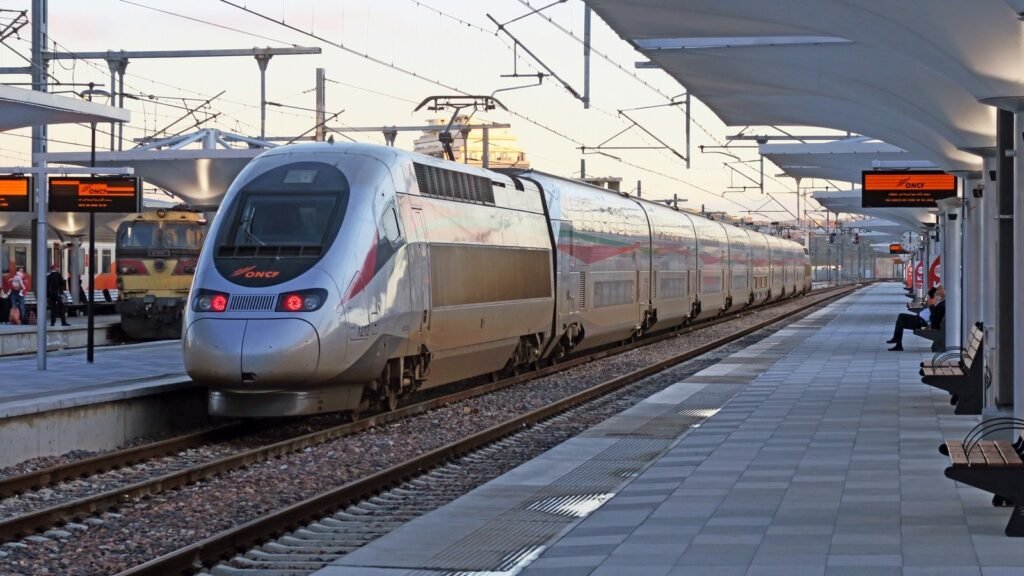
Source: Wikipedia
Morocco’s trains could be carrying around 100 million passengers a year by 2030, with the National Railways Office (ONCF) earning 10 billion dirhams, according to projections in the report on state-owned enterprises and public institutions that accompanies the 2027 Finance Bill.
Those targets rest on a 96-billion-dirham investment programme. Its biggest single item, MAD 53 billion, will extend the high-speed line beyond Kenitra to Marrakech, along with the infrastructure and equipment that go with it.
Where the money goes
Rolling stock takes MAD 29 billion, covering 168 new-generation trains. Another 14 billion dirhams is set aside for maintenance. Of that sum, 8 billion will serve the high-speed extension and the infrastructure used by regional express trains, and the remaining 6 billion will go to lines already in service.
Construction on the Kenitra-Marrakech line, which runs 430 kilometres, started in April 2025, the report notes. That September, ONCF launched a separate programme dedicated to rail in Casablanca.
Under that programme, the city is to get a multimodal hub named Casablanca-South, as well as stations at Mohammed V International Airport and the new Grand Hassan II Stadium. Trains between Mohammedia and Nouaceur are also set to run more often.
Revenue path to 2029
The office projects turnover rising each year: 6.051 billion dirhams in 2027, then 6.565 billion the year after and 7.045 billion by 2029. Capital expenditure for 2027 alone is put at MAD 29.021 billion.
For the current year, ONCF expects revenue of MAD 5.276 billion, operating profit of 216 million dirhams and a net deficit of 652 million. Investment is projected at MAD 18.2 billion, down almost 4% from 2025.
More passengers, more freight
Ridership edged up 1% in 2025 to 55.6 million. Conventional services accounted for nearly 50 million of those travellers, while the Al Boraq high-speed train carried 5.6 million, a 3% increase.
Ticket income grew 5% to MAD 2.905 billion. Al Boraq’s takings rose 9% to 848 million dirhams, and conventional lines generated 2.057 billion dirhams, a 4% gain on the year before. The occupancy rate stood at 65%, and punctuality at 87%.
On the cargo side, ONCF moved 23.2 million tonnes, 9.4% more than in 2024, earning MAD 1.989 billion, an 8% rise. Phosphates alone brought in 1.245 billion dirhams; all other goods generated MAD 744 million, a 6% gain.
Losses deepen
Taken together, the office’s revenue reached MAD 6.191 billion in 2025, a 7% improvement on the 5.809 billion recorded in 2024. Operating profit jumped from MAD 81 million to MAD 231 million.
The bottom line nonetheless worsened, with the net deficit growing from MAD 1.313 billion to MAD 1.404 billion. The report points mainly to costs tied to infrastructure, in particular depreciation and financing charges.
Half-year figures for 2026 show revenue of MAD 2.479 billion at end-June, 2% higher than a year earlier. Over the same six months, the deficit stood at 716 million dirhams, and ONCF had invested MAD 4.834 billion.