Morocco secures €365 million EIB financing for transport networks
Morocco secured €365 million in new financing from the European Investment Bank, strengthening investment in the country’s railway and motorway infrastructure. The agreements were signed in Rabat and focus on improving network resilience, climate adaptation, and transport connectivity.
The financing package was announced during the first official visit to Morocco by European Investment Bank President Nadia Calviño since taking office. Her visit, which ran from June 29 to July 1, included meetings with senior Moroccan officials and visits to projects supported by the bank.
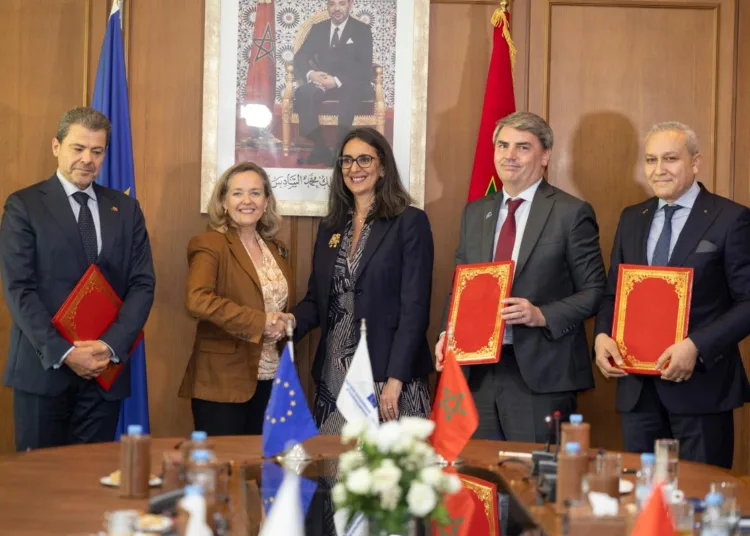
The agreements were signed by representatives of the European Investment Bank, Morocco’s National Railway Office (ONCF), and the European Union Delegation to Morocco. Morocco’s Minister of Economy and Finance Nadia Fettah attended the ceremony alongside Calviño.
The first operation includes a €50 million loan from the European Investment Bank and a €15 million grant from the European Union for the rehabilitation of Morocco’s railway network. The funding will support infrastructure upgrades and climate resilience measures across the national rail system.
The second operation provides a €300 million loan to Autoroutes du Maroc for a motorway resilience project. The investment aims to strengthen the road network against climate-related risks while improving safety and operational reliability.
Both projects benefit from European Union guarantees and form part of broader efforts to modernize transport infrastructure, support sustainable mobility, and reinforce economic links between Europe and Africa.
Calviño described Morocco as a strategic partner for the European Investment Bank and said the agreements mark a new stage in cooperation between Morocco and the European Union. She said the bank’s priorities in the kingdom focus on shared prosperity, social progress, resilience, and high-impact investments.
Fettah emphasized the long-standing partnership linking Morocco, the European Union, and the European Investment Bank. She noted that the relationship spans nearly five decades and has evolved beyond individual projects toward a broader development strategy centered on inclusion, social cohesion, and regional integration.
Daniele Dotto of the European Union Delegation to Morocco described the partnership as strong and dependable. He said European institutions continue to provide financial and technical support for infrastructure development and economic growth.
During her visit, Calviño said the European Investment Bank plans to invest more than €700 million in Morocco during 2026. She noted that financing activity in the country has tripled over the past five years.
The planned investment follows a record year in 2025 when the bank signed €740 million in financing agreements in Morocco through EIB Global, its division responsible for operations outside the European Union. That represented the institution’s largest annual commitment to the kingdom since 2012.
Globally, the European Investment Bank Group approved €100 billion in financing and advisory operations during 2025, supporting more than 870 projects.
Calviño attributed Morocco’s growing attractiveness to investors to economic reforms, macroeconomic stability, and a strong financial sector. She said efficient procedures, access to financing, and modern infrastructure help convert investor confidence into jobs and economic opportunities.
She also described Morocco as a key link between Europe, Africa, and the Atlantic region, underscoring its growing economic and industrial importance.
The visit coincided with the twentieth anniversary of the European Investment Bank’s permanent presence in Morocco. Since beginning operations in the country in 1979, the institution has committed more than €12 billion to projects covering transport, energy, education, water, sanitation, health, and private sector development.
Major projects supported by the bank include the Tanger Med port, the Ouarzazate solar complex, the Euro-Mediterranean University of Fes, and the Medusa submarine fiber optic cable.
Recent financing has also supported reconstruction efforts following the Al Haouz earthquake. In June, the bank released a second €500 million tranche for recovery projects, bringing its total commitment to €1 billion.
The European Investment Bank is also expanding cooperation with the Mohammed VI Investment Fund to attract private investment into infrastructure, businesses, and venture capital projects. The institution said it will continue working with Moroccan authorities and international partners to ensure long-term economic and social impact.