


Istanbul: Türkiye displays 100 antiquities sent back by the US, opens Boubon show
Türkiye antiquities returned by the US went on show in İstanbul as Boubon bronzes were reunited, the Türkiye Tourism Promotion and Development Agency said.
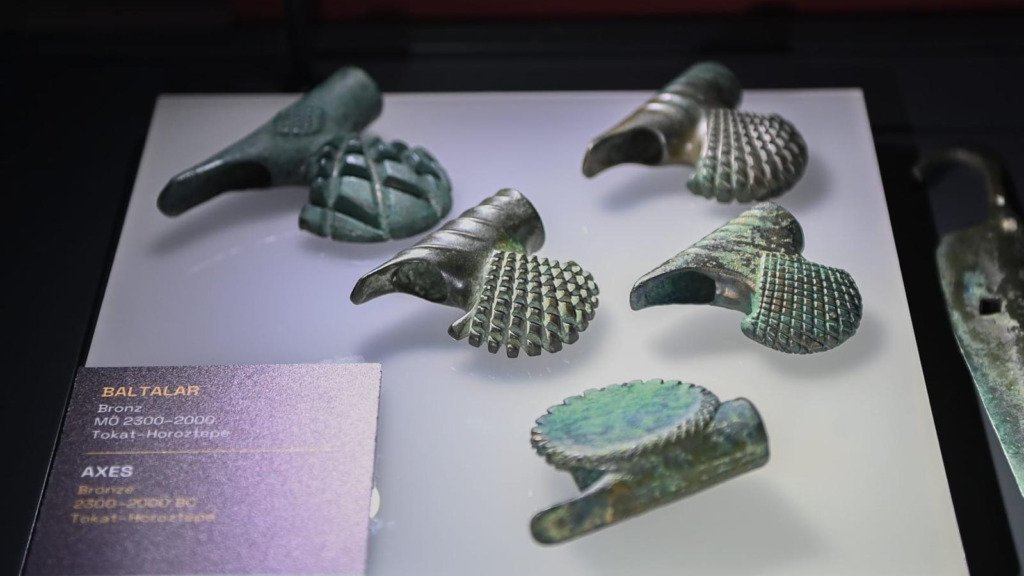
Photo: Türkiye Tourism Promotion and Development Agency
A batch of 100 antiquities sent back to Türkiye by the United States has gone on public view at the İstanbul Archaeology Museums, where Minister of Culture and Tourism Mehmet Nuri Ersoy also inaugurated an exhibition titled “No Way Out: Boubon”. The Türkiye Tourism Promotion and Development Agency gave the details in a statement issued on Friday, November 6.
The objects cover a wide span, the agency said, with pieces as varied as early instruments for making music and decorated building reliefs. Ankara credits their recovery to legal and scientific diplomacy conducted abroad by the Ministry of Culture and Tourism.
Auction halted in May
The statement singled out an episode from May 2026. That month, an American auction house listed items of Anatolian origin. The ministry moved at once, supplying documentation and scientific data to the Manhattan District Attorney’s Office and to Homeland Security Investigations (HSI). The sale was stopped and the pieces were sent back.
Matthew Bogdanos, Manhattan Deputy District Attorney and Head of Trafficking Unit, attended the press conference. Ersoy thanked his office and HSI, as well as the Ministry of Foreign Affairs and Türkiye’s Consulate General in New York, for their help, and credited Turkish Airlines with bringing the shipment home safely.
“Our goal is not merely to move artefacts from one display case to another, but to re-evaluate them within their stories and the cultural context to which they belong.”
The minister added that his country would keep combating trafficking in cultural property with determination.
Bronze Age metalwork and Archaic plaques
Forty items trace back to Horoztepe, a site in Tokat’s Erbaa district, in Türkiye’s Central Black Sea region. Weapons, metal vessels and instruments used in ceremonies make up this group, which dates to between 2300 and 2000 BCE and illustrates the skill of Anatolian metalworkers in the Early Bronze Age. Looted nearly 70 years ago, the pieces were recovered after experts weighed evidence drawn from several scientific and historical disciplines together.
Düver, a village in Burdur, supplied 44 plaques of fired clay that once covered and roofed ancient buildings. They belong to the Archaic Period, the 6th century BCE. Specialists compared their decoration, construction and style, then followed their trail through archives and collection records. Earlier batches came back from the USA in 2022, Denmark in 2024 and the Virginia Museum of Fine Arts in 2025; the last remaining group, from the J. Paul Getty Museum in Los Angeles, has now made the set whole. A planned project will place the Düver plaques alongside other objects kept by the İstanbul Archaeology Museums.
Among single highlights are a portrait originating in Aphrodisias, an ancient city in Aydın in the country’s southwest, plus goddess statuettes and masks used in the theatre.
Boubon bronzes reunited
The new exhibition focuses on Boubon, an ancient city close to İbecik Village in Burdur’s Gölhisar district. Its bronze statues originally stood in the Sebasteion, a shrine honouring Roman emperors and the imperial family. Illegal digging in the 1960s saw them broken into pieces and taken out of the country.
Investigators matched marks on the statues’ feet to the stone bases they once stood on, and analyses of lead isotopes and soil confirmed the fit. Heads, torsos and limbs that had ended up in different countries and collections are now shown together, among them figures of Emperors Lucius Verus, Septimius Severus, Caracalla and Marcus Aurelius.
According to the agency, the returns have revived research at the site, where Turkish archaeologists resumed digging in 2023 under the coordination of the Burdur Archaeology Museum.
 Assem Laalami Brings Twenty Years of Film and Studio Work to THE E.L Signature
 Family Code reform: Kenitra lawyer urges government to send bill to Parliament
 Waitrose Christmas ad: Keira Knightley in wedding gown in sequel teaser
 Green March 51st anniversary: flag ceremonies in Settat and Dakhla, rally in Laayoune
 Mubadala Energy aims to double output in ten years, with gas at around 70%

Comments (0)