



Pot-au-feu: Julie Andrieu’s three tips for tender beef and a richer broth
Julie Andrieu’s pot-au-feu tips: mix three beef cuts, brown the meat the day before and add vegetables in stages for a fuller, richer broth.
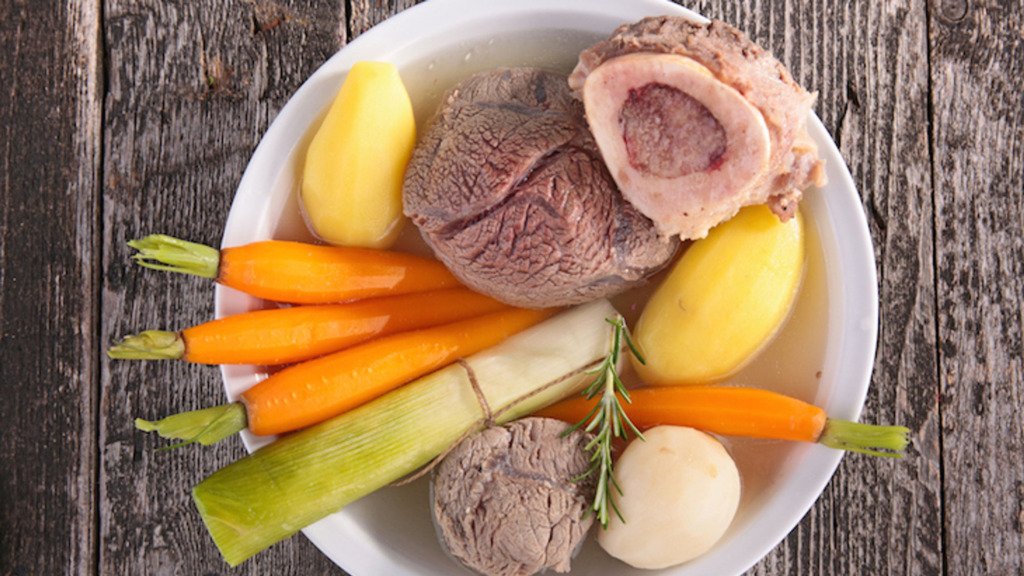
Photo: James Beard Foundation
A good pot-au-feu depends less on technique than on the meat chosen and the time given to it. Julie Andrieu builds her version around three simple ideas: combine different beef cuts, prepare the meat a day ahead, and add the vegetables gradually rather than all at once.
The French classic of beef simmered slowly with vegetables suits anyone cooking at home this winter. Her approach aims to give a deeper broth and softer meat with less effort on the day itself.
Three textures of beef
Her first rule is to mix three kinds of cut. A lean piece such as macreuse, from the shoulder, keeps its shape during long cooking. A gelatinous cut such as gîte or jumeau makes the meat tender and gives the broth a silky body.
The third element is a little fat, from plat de côtes (short ribs) or flanchet (flank). These are inexpensive cuts, and they flavour the whole pot. Together, the three give a rich broth, melting meat and portions that hold together on the plate.
If one of these cuts is unavailable, a butcher’s or supermarket counter usually offers alternatives. Paleron or beef cheek can serve as the lean piece, oxtail or shank as the gelatinous one, and short ribs or brisket as the fat. Where a cut is missing, a few marrow bones will also enrich the broth.
Browning the meat the night before
Andrieu’s second tip calls for some planning. She browns the meat the day before, covers it with lukewarm water and leaves it to rest overnight. By the next day, the meat has taken on more flavour and the broth is more fragrant.
All that remains is to put the pot on the heat. She presents this as a practical time-saver for busy evenings or for large weekend meals.
Vegetables in stages
The third principle is not to tip everything into the pot at the same moment. Adding the vegetables one after another lets each keep its bite or its softness, while a gentle simmer lets the flavours develop.
Carrots, turnips and leeks form the traditional base. Celeriac, parsnip, sweet potato or green cabbage add colour and flavour without making the dish harder to prepare.
For a more concentrated broth, keep a close watch on the heat and extend the cooking time gently. The longer the pot simmers, the stronger the flavours become.
Cooking time and storage
A pressure cooker is not needed. A large pot with a lid and a low flame are enough, provided the broth is skimmed regularly and left to simmer for at least two to three hours. Longer cooking makes the meat more tender.
The dish also improves when made the day before. Once it has cooled, it goes into the refrigerator in its own broth. The next day, the layer of fat on the surface can be lifted off before reheating gently. Pot-au-feu keeps for up to three days in the fridge.
Using the leftovers
Leftover meat can be shredded for croquettes, a warm beef salad, a hachis parmentier or homemade ravioli. The broth works as a base for vegetable soup, risotto or pasta, and spare beef can also fill a sandwich the following day.
 BYD’s Yangwang U9 Xtreme wrecked on a closed track before 500 km/h attempt
 Boualem Sansal in Rabat: Morocco is “an outstanding country in every field”
 Amine Harit: Marseille Revival Puts Atlas Lions Return Back on the Table
 Treviso: Italian-Moroccan International Festival closes 12th edition
 Chefchaouen: province activates hotlines to tackle winter weather and isolation


Comments (0)