Moroccan phosphate waiver exposes America’s fertilizer dependency
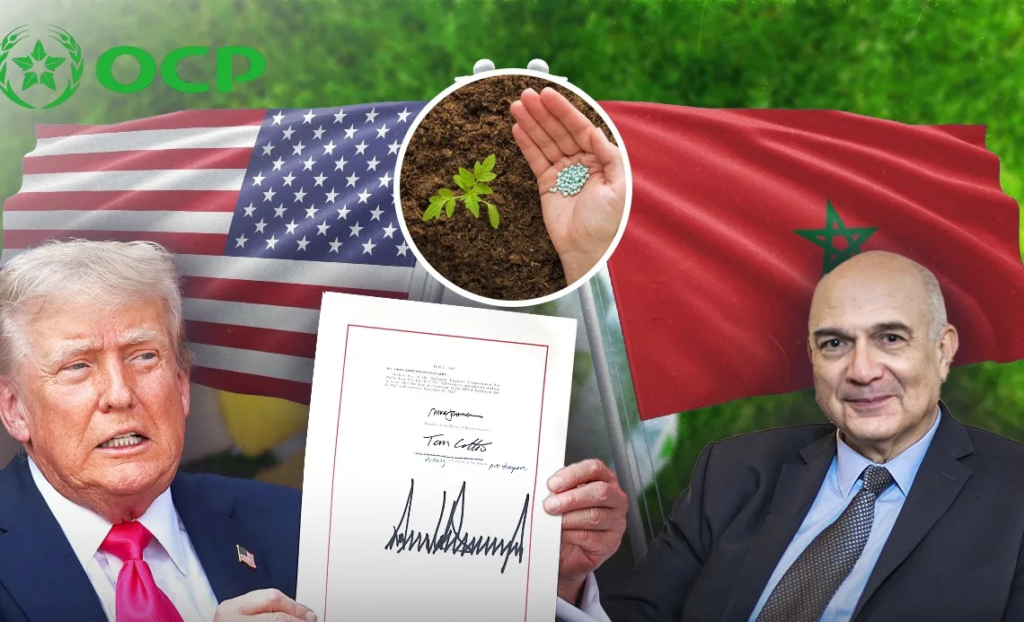
The Moroccan phosphate waiver announced by the United States on June 29 reflects a strategic shift driven by necessity rather than policy preference. Faced with mounting fertilizer supply pressures, Washington temporarily suspended selected antidumping and countervailing duties on Moroccan phosphate imports for eight months, acknowledging the critical role Morocco plays in global agricultural supply chains.
At first glance, the decision appeared to be a technical trade measure. In practice, it signaled that the world’s largest agricultural economy could not maintain restrictive barriers against Moroccan phosphate while securing sufficient fertilizer supplies for domestic farming.
Rather than relying on common trade mechanisms such as Section 232 national security investigations, Section 301 actions, or emergency powers under the International Emergency Economic Powers Act, the administration invoked Section 318 of the Tariff Act of 1930. The rarely used provision allows duty-free imports of essential supplies during emergencies. By applying it to phosphate fertilizer, Washington effectively treated a key industrial input as an emergency resource necessary to protect food production.
The unusual legal approach reflected the severity of disruptions affecting fertilizer markets. Since late February, instability around the Strait of Hormuz has disrupted the movement of sulfur and ammonia, two essential inputs for fertilizer production. Phosphate rock must be processed with sulfuric acid before it can be used in agriculture, making sulfur supplies vital to the entire production chain.
As shipping constraints intensified, fertilizer markets tightened and prices rose. The United States, whose phosphate production has declined by more than half since 1995, lacked sufficient domestic capacity to offset global shortages. The country therefore remained heavily dependent on imported supplies.
The financial consequences for American farmers became increasingly difficult to ignore. Diammonium phosphate prices at the New Orleans market approached $710 per tonne during the spring, compared with $647.50 a year earlier. According to estimates cited by the American Farm Bureau Federation, around 70% of growers struggled to afford adequate fertilizer supplies. At the same time, net farm income is projected to fall to $153.5 billion in 2026 while sector debt reaches a record $624.7 billion.
Timing added further urgency. Much of the annual phosphate application occurs during a limited period between autumn and early spring. Any disruption during that window can directly affect crop yields, food production, and consumer prices in subsequent months.
The Moroccan phosphate waiver also underscored Morocco’s unique position within the global phosphate industry. Through OCP Group, Morocco controls more than 70% of known global phosphate reserves and accounts for roughly 31% of the world phosphate market. An assessment by the African Development Bank described the sector as highly concentrated, giving Morocco exceptional influence over a resource with no practical synthetic substitute.
Unlike nitrogen fertilizers, which can be produced from atmospheric sources, phosphorus must be extracted from mineral deposits. This geological reality limits alternative supply options and increases the strategic value of major producers.
Years of investment by OCP in vertically integrated operations, spanning mining to finished fertilizer production, strengthened Morocco’s ability to maintain exports during periods of market disruption. As competitors faced logistical and supply challenges, Morocco emerged as one of the few reliable suppliers capable of meeting international demand.
The geopolitical dimension further reinforced Washington’s decision. China and Russia collectively account for a significant share of processed phosphate exports and have previously restricted shipments to protect domestic interests. China, for example, curtailed fertilizer exports in 2024. Continued barriers against Moroccan imports could have increased reliance on suppliers whose export policies are more closely linked to strategic national priorities.
The latest development also marks a significant turning point in a trade dispute that began in 2020. That year, The Mosaic Company filed a complaint alleging unfair subsidies benefiting Moroccan phosphate exports. In response, U.S. authorities imposed a 19.97% countervailing duty in 2021, sharply reducing OCP’s presence in the American market.
Subsequent administrative reviews produced varying duty rates. In December 2025, the U.S. Court of International Trade reduced the levy to 2.11% after ruling in favor of OCP. The government later abandoned its appeal in March 2026.
Meanwhile, phosphate and potash were added to the U.S. list of critical minerals, and authorities used the Defense Production Act to strengthen supplies of elemental phosphorus. These moves gradually shifted phosphate from a trade issue into a matter of economic and national security.
The temporary waiver does not permanently eliminate trade restrictions. The measure remains tied to emergency conditions and the broader review process surrounding existing duties. Nevertheless, it represents a clear recognition of Morocco’s strategic importance to global food security.
More significantly, the decision highlights a broader reality. Geological resources can outweigh trade barriers when supply chains come under stress. As phosphate becomes increasingly important for both food production and lithium iron phosphate battery technologies, Morocco’s influence over a critical global resource is likely to grow.
Washington’s latest action ultimately reflected a simple calculation. Access to Moroccan phosphate had become more valuable than maintaining the trade restrictions originally designed to limit it.