Rivian buys UK startup Third Dimension to speed up self-driving work
Rivian has acquired UK startup Third Dimension, whose AI turns images and video into 3D worlds, to speed up its self-driving work, James Philbin said.
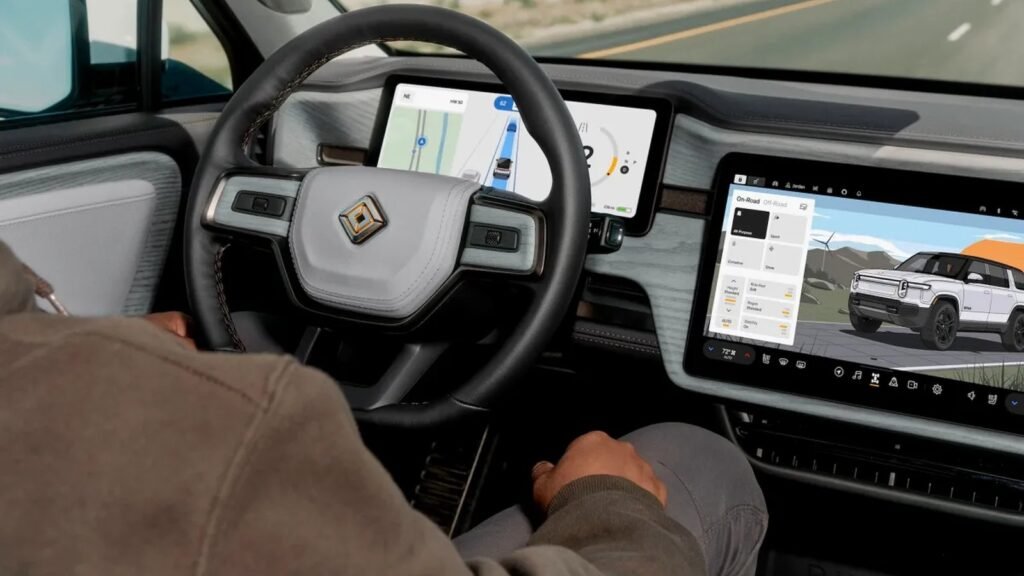
Photo: Rivian
American electric vehicle maker Rivian has bought Third Dimension, a British startup whose software uses artificial intelligence to build realistic 3D environments from photos and video. Rivian intends to apply the technology to its driver-assistance systems and to the autonomous driving platform it is building for robotaxis destined for Uber.
Neither company disclosed the financial terms of the deal. Third Dimension’s 15 employees, most of them based in the UK, will join Rivian’s autonomy and AI team, which is run by James Philbin. Philbin said the purchase also opens the door to growing Rivian’s AI hub in London.
A gaming tool repurposed
Chief executive Tolga Kart and Piotr Sokólski set up Third Dimension in 2024. The startup brought in $7 million at the seed stage from investors including Abstract Ventures, MVP, Soma Capital and Solari Capital. Its software was first designed to make video game production faster, though the founders had also looked at uses in defence and autonomous vehicles.
Under its new owner, the team will work solely on automated driving. Kart said the engineers welcomed the chance to concentrate on a single challenge.
“I think as a small company, having to serve many, many different masters is very hard, and so we’re very excited to come work on a problem that has such an amount of scale, where our technology makes a true difference,” Kart said.
Closing the sim-to-real gap
Developers of autonomous vehicles rely on simulation to train their systems and check that they work. Such simulators have traditionally run on rendering or game engines, often fed with synthetic data. According to Kart, these virtual settings may resemble reality, yet a gap persists, and the usual answer has been to pour ever more data into them.
Third Dimension instead uses AI to reproduce the physical world. Paired with the driving data Rivian already gathers, that could yield a valuable simulator. Philbin said Rivian wanted to turn real situations into ones it could replay and alter, moving cameras, shifting other road users, or changing light and weather. He added that the company had carried out a “pretty extensive kind of evaluation of a lot of different providers” before choosing the startup.
The material feeds in from a large fleet of R1T pickups, R1S SUVs, delivery vans and R2 SUVs whose owners have switched on external camera sharing, running into the tens of thousands of vehicles. Rivian aggregates and anonymises this material to train its driving models, and Philbin said customer vehicles upload well over 400,000 sequences each day. The new tools should let engineers recreate difficult conditions instead of waiting for rare edge cases to happen on real roads, he said, describing validation as the key stage in deciding whether a system “is good to ship”.
Hands-free driving and robotaxis
Rivian currently sells “Universal Hands-Free” software, which allows drivers to remove their hands from the wheel on highways as long as they keep watching the road. By the end of this year, the company intends to release a version able to manage a whole trip on both city streets and highways without the driver touching the wheel, though supervision and readiness to take control will still be required.
Full autonomy is the longer-term goal. Rivian plans to deploy it in robotaxi versions of the R2 SUV, which are due to be offered through the Uber app in 2028.