2027 finance bill: Lekjaa puts cost of social priorities at MAD 62 billion
The 2027 finance bill puts the social priorities at about MAD 62 billion, Minister Fouzi Lekjaa told Parliament, with higher support, pensions and youth aid.
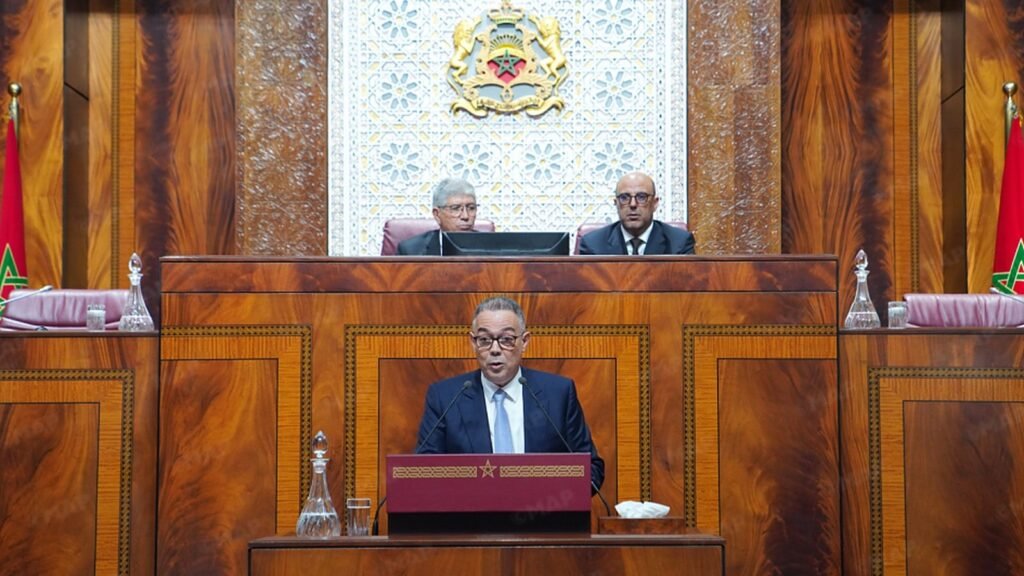
Photo: MAP
Minister of Economy, Finance and Public Efficiency Fouzi Lekjaa said on Friday that the government’s social priorities will carry an overall cost of about MAD 62 billion. He gave the figure while presenting the 2027 finance bill to a joint plenary session at the House of Representatives.
“The government has honoured its commitments since the first finance bill it presented in this term,” the minister said. He listed the main priorities: bringing staple prices back to reasonable levels, raising household purchasing power, finishing the Royal project to extend social protection to all, and launching a national integrated youth programme for 2027-2031.
Support, wages and pensions
The minimum level of direct social support will rise gradually from MAD 500 to MAD 1,000 by the end of the current term. Mr. Lekjaa said the first step is an increase of MAD 100 in 2027, costing about MAD 3 billion. Eligibility will be based mainly on households’ actual income rather than the socio-economic index.
The bill’s explanatory note sets aside MAD 19.4 billion through the Compensation Fund to keep subsidising butane gas, sugar and national soft-wheat flour. It also states that the State will pay in full any monthly electricity bill of MAD 100 or less.
A gradual income tax reform will run from 2027 to 2031. Under the reform, the tax-exempt income threshold rises from MAD 40,000 to MAD 60,000 a year, and the top marginal rate falls from 37% to 30%.
The note says the minimum retirement pension will rise to MAD 1,700 a month in 2027, a first stage towards a target of MAD 3,000. Widows’ pensions will also equal 100% of the deceased spouse’s pension, instead of 50%.
From February 1, 2027, Law No. 54.23 will transfer management of public-sector compulsory health insurance from CNOPS to the National Social Security Fund.
Health, education and housing
The health budget rises to MAD 45.4 billion, roughly MAD 3 billion more than in 2026, Mr. Lekjaa said, with 8,000 budgeted posts attached. The funds will go towards the new university hospital centre in Casablanca, centres in Beni Mellal, Guelmim and Errachidia, and upgrades to 1,600 primary care facilities and 90 hospitals.
Education, higher education and training together will receive MAD 121.3 billion, an increase of MAD 5.3 billion, with 17,874 posts. Plans include 49 new university institutions and three cities of trades and skills in the Guelmim-Oued Noun, Fès-Meknès and Drâa-Tafilalet regions. Housing gets MAD 10.4 billion in investment credits. The direct housing aid scheme had reached about 128,000 beneficiaries by the end of September 2026.
Youth programme
About MAD 6 billion is earmarked for the 2027-2031 youth programme. Each year, it aims to train 100,000 young people based on companies’ needs and give around 100,000 more their first work experience. It will also raise apprenticeship capacity to between 150,000 and 200,000 people and support 12,000 businesses.
“The government considers protecting the middle class part of an integrated economic and social project,” the minister said.
Regions and investment
Direct State transfers to the regions will rise to at least MAD 12 billion from 2027, up from MAD 10 billion previously, according to the explanatory note. A further MAD 25 billion is allocated in 2027 to the new generation of integrated territorial development programmes, whose total envelope stands at MAD 210 billion over eight years.
The bill plans total public investment of MAD 400 billion in 2027. It targets growth of 3.7% and aims to keep the budget deficit at 3% of GDP.