Morocco becomes Renault’s second-largest global production hub

Morocco has strengthened its position as a key pillar of Renault’s industrial network, becoming the company’s second-largest manufacturing base worldwide after France. The country produced 394,000 vehicles for Renault Group in 2025, accounting for nearly one out of every six vehicles sold by the automaker globally.
According to Renault, its factories in Tangier and Casablanca produced vehicles that were exported to 63 international markets during 2025. Exports represented 82% of total production. Key destinations included France, Spain, Italy, Germany, and Turkey.
Renault employs nearly 10,000 people across its Moroccan operations. The Tangier factory alone provides jobs for around 6,000 workers and remains the largest automobile manufacturing facility in Africa.
The company has maintained a presence in Morocco for almost 100 years. Since 2016, partnerships between Renault and the Moroccan government have expanded the country’s automotive supply chain. Today, 87 Tier 1 suppliers support production at the Tangier and Casablanca plants, with many located in the Tanger Med free trade zone near the factories.
Renault and Dacia together control 38% of Morocco’s domestic vehicle market. Morocco is now Renault Group’s eighth-largest market by sales volume worldwide. As of May 2026, the Dacia Logan, Dacia Sandero, Renault Clio, and Renault Express were among the country’s best-selling models.
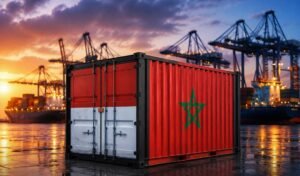
One of the main drivers of this success is the close connection between manufacturing and logistics. The Tanger Med port complex is located only a few kilometers from the Tangier factory. In 2025, the port handled 161 million tonnes of cargo and more than 11.1 million containers.
Tanger Med is the largest port in Africa and the Mediterranean region and ranks among the world’s leading ports. Its vehicle terminal covers 20 hectares and can process up to one million vehicles annually. Shipping routes connect the port directly to 24 countries, including Australia, South Africa, Romania, Slovenia, and Turkey.
More than 1,500 companies operate in the economic zones surrounding the port. This concentration of industrial activity links production facilities, suppliers, logistics services, and shipping infrastructure within a single geographic area along the Strait of Gibraltar.
Renault says this integration creates a highly efficient automotive ecosystem. The company benefits from the close proximity of assembly plants, suppliers, and transport networks, reducing costs and improving operational speed.
The scale of logistics operations reflects this model. Each year, about 69,100 trucks and 12,000 containers deliver parts and materials to Renault’s Moroccan plants.
Finished vehicles are transported through 26,400 trucks, 1,440 trains, and 290 ships annually. Around 8,000 vehicles leave the Tangier factory every week. Renault also operates a dedicated quay at the Tanger Med port.
Two railway lines connect directly to the Tangier plant, allowing vehicles to move from production lines to shipping terminals through multiple daily rail services. Rail transport helps address trucking capacity constraints and reduces carbon emissions by about 90% compared with road transport.
Renault has also invested in digital supply chain management. Three artificial intelligence-powered control towers oversee operations.
The Inbound Control Tower monitors deliveries of parts and components to factories and identifies potential disruptions. The Outbound Control Tower tracks vehicle shipments by road, rail, and sea until they reach commercial networks. A third system, known as the Business Continuity Plan Control Tower, monitors global risks such as labor strikes, severe weather events, and geopolitical disruptions to maintain uninterrupted operations.
Environmental performance has become another important aspect of the Tangier facility. Biomass heating systems and wind power provide around 90% of the plant’s energy needs, reducing reliance on fossil fuels. The site also operates a closed-loop water recycling system that limits industrial water consumption.
Renault supports workforce development through the Institute for Training in Automotive Industry Professions, known as IFMIA, which it has managed since 2011. The institute has delivered more than 3.2 million hours of training focused on automation, robotics, and vehicle electrification. Around 30% of its activity supports suppliers, industrial partners, and youth employment programs in the Tangier region.
Morocco’s automotive market also recorded strong growth. Vehicle sales increased by 33% in 2025, driven by new product launches, stronger consumer demand, improved financing conditions, and the arrival of new market participants.
Renault executives say Morocco has become one of the group’s most important industrial platforms. Supported by local sourcing, advanced logistics, skilled labor, and strong public-private cooperation, the country now plays a central role in Renault’s global manufacturing strategy and international export operations.