Casablanca stock exchange sees OPCVM dominance despite lower trading volumes
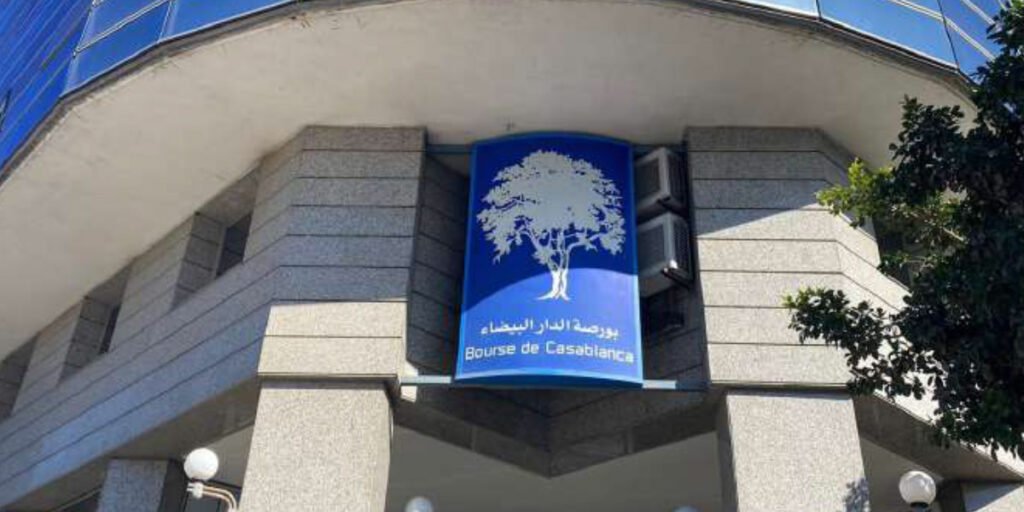
The Casablanca stock exchange remained largely driven by institutional investors during the first quarter of 2026, even as trading volumes declined and major market indices moved lower. Data released by the Moroccan Capital Market Authority (AMMC) show that collective investment schemes known as OPCVMs and Moroccan corporate investors accounted for most equity market activity during the period.
The first quarter reinforced the dominant role of institutional investors in Morocco’s stock market. According to the AMMC’s investor profile report, OPCVMs and Moroccan legal entities represented a combined 65.5% of flows on the central equities market between January and March 2026. Their influence remained strong despite weaker market conditions and declining benchmark indices.
Trading activity slowed considerably during the quarter. Total transaction volume across the central market and block trades reached 26.9 billion dirhams, compared with 38.5 billion dirhams in the fourth quarter of 2025 and 33.3 billion dirhams in the first quarter of 2025. The decline was visible on both a quarterly and annual basis.
Market performance reflected this softer environment. The MASI index fell 8.9% during the first three months of the year, while the MASI 20 dropped 12.4%. Compared with the same period a year earlier, the indices were down 3.35% and 10.03% respectively. Despite weaker market performance, total market capitalization reached 963.03 billion dirhams at the end of March, marking a 4.08% increase from a year earlier.
The central market remained the primary source of liquidity, accounting for 98% of total trading activity with 26.3 billion dirhams in transactions. However, this represented a decline of 16.7% compared with the first quarter of 2025 and 15.3% compared with the previous quarter. Block trades contributed only 568.8 million dirhams, down sharply from 1.72 billion dirhams recorded a year earlier.
Monthly data showed changing market momentum. Trading volumes on the central equities market reached 8.54 billion dirhams in January before falling to 7.45 billion dirhams in February. Activity then rebounded to 10.15 billion dirhams in March, making the final month of the quarter the strongest contributor to overall turnover.
OPCVMs remained the leading market participants. They generated 38.4% of quarterly trading volume on the central equities market, ahead of Moroccan corporate investors at 27.2% and Moroccan retail investors at 22.6%. Foreign corporate investors accounted for 6.1% of activity, while transactions executed through banking networks represented 5.4%. Foreign individual investors contributed only 0.3%.
Institutional funds were net buyers during the quarter. OPCVMs purchased shares worth 10.8 billion dirhams and sold 9.3 billion dirhams. Their purchases declined by 26.8% from the same period in 2025, while sales increased by 6.1%, indicating a more selective investment approach while maintaining a central role in market activity.
Moroccan companies adopted a different strategy and emerged as net sellers. Their sales reached 7.9 billion dirhams compared with 6.3 billion dirhams in purchases. Both buying and selling activity declined from the previous year, with purchases down 10.2% and sales falling 31.7%.
Moroccan retail investors remained net buyers. They purchased shares worth 6.2 billion dirhams and sold 5.6 billion dirhams. Although their overall trading volumes contracted compared with a year earlier, they continued to play a significant role in market activity. Purchases declined by 19.8% while sales dropped by 29.5%.
Foreign investors showed renewed interest in Moroccan equities. Foreign corporate investors bought shares worth 1.63 billion dirhams during the quarter, an increase of 70.2% from the first quarter of 2025. Their sales totaled 1.55 billion dirhams, down 7.5% year on year. While their overall market share remained limited, the figures suggest a selective return to buying among international investors.
Investors operating through banking networks recorded 1.7 billion dirhams in sales and 1.2 billion dirhams in purchases. Unlike most other investor categories, both figures increased from a year earlier, with sales rising 19.1% and purchases growing 11.7%.
Despite lower trading volumes, operational activity increased significantly. The number of stock exchange orders on the central equities market climbed to 869,262 during the first quarter, up 59.2% from a year earlier and 9.4% from the previous quarter. The number of contracts also rose sharply, reaching 416,399 compared with 282,947 in the first quarter of 2025, an increase of 47.2%.
These figures indicate that market participants executed more transactions but in smaller average amounts. Trading became more fragmented, reflecting active participation despite lower aggregate volumes.
The AMMC report also confirmed the overwhelming importance of domestic investors. OPCVMs, Moroccan companies, and Moroccan retail investors continued to account for most market flows. Foreign investors remained present and showed signs of renewed buying interest, but their overall contribution remained modest.
The first quarter therefore presented a mixed picture for the Casablanca stock exchange. Trading volumes and benchmark indices declined, yet order activity and transaction counts increased substantially. Institutional investors maintained their leading role, retail investors remained active buyers, and foreign investors cautiously returned to the market, setting the stage for developments in the second quarter.