West Africa emerges as Morocco’s next frontier for growth
Morocco is positioning West Africa as a central pillar of its long-term economic strategy, with Côte d’Ivoire increasingly viewed as a gateway to regional growth, industrial expansion, and cross-border investment.
That vision took center stage during the Consultative Group meeting held in Abidjan on July 8 and 9, where Côte d’Ivoire presented its National Development Plan for 2026 to 2030. The ambitious roadmap includes nearly 900 projects with projected investments estimated at €175 billion, with around 70% expected to come from private sector participation.
A large Moroccan delegation, organized by the General Confederation of Moroccan Enterprises (CGEM), attended the event. More than 100 companies and 260 executives participated, signaling strong interest from Moroccan businesses in securing opportunities linked to the development program.
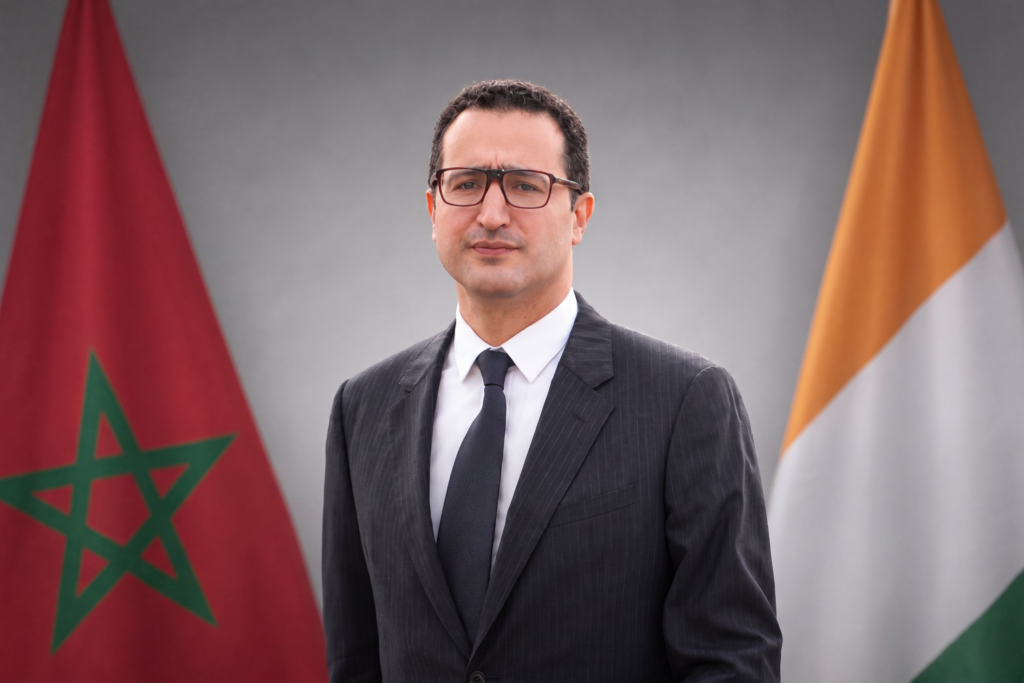
Speaking on the sidelines of the gathering, Morocco’s ambassador to Côte d’Ivoire, Othman El Ferdaous, argued that the Kingdom’s future economic expansion will increasingly depend on integration with West African markets and the creation of regional value chains.
Côte d’Ivoire at the center of Morocco’s African strategy
According to El Ferdaous, Morocco should no longer view Côte d’Ivoire merely as an export destination. Instead, the country should be considered a strategic platform for joint growth, industrial cooperation, and access to some of Africa’s fastest-growing economies.
He highlighted demographic trends as a major driver behind this approach. West Africa is expected to experience rapid population growth in the coming decades, creating vast new consumer markets and industrial opportunities.
The ambassador described Côte d’Ivoire as an attractive investment environment thanks to its long period of economic growth, stable currency, strong trade performance, and influential position within the West African Economic and Monetary Union.
Recent assessments by international financial institutions have further strengthened investor confidence. Côte d’Ivoire has improved its standing in debt sustainability evaluations, reinforcing its reputation as one of the region’s most stable economic performers.
For Moroccan policymakers and investors, these developments support a broader vision of African economic integration built on partnerships between African countries rather than dependence on external markets.
Major Moroccan companies eye new opportunities
The Moroccan delegation reflected the breadth of sectors targeted by the Ivorian development plan.
Representatives came from finance, infrastructure, energy, healthcare, agriculture, mining, engineering, digital services, education, and sports.
Among the participating institutions were CDG, Tamwilcom, Nareva, Taqa, ONHYM, Akdital, Sothema, Managem, CIMAF, HPS, M2M Group, JESA, Novec, and several major construction and logistics operators.
CGEM President Mehdi Tazi emphasized that many of these companies view Côte d’Ivoire as a strategic destination for future expansion beyond Morocco’s domestic market.
Moroccan investment in Côte d’Ivoire has already reached significant levels. Direct investment from Morocco totaled approximately MAD 1.24 billion in 2024, supporting activities across banking, telecommunications, fertilizers, pharmaceuticals, food security, real estate, sugar production, and business services.
Discussions during the event also involved international financial institutions, including the African Development Bank and the International Finance Corporation, with a focus on mobilizing private capital and strengthening project financing mechanisms.
The push for co-industrialization
One of the most important themes emerging from the discussions was the concept of co-industrialization.
El Ferdaous argued that African economies must move beyond a model in which raw materials are exported and finished products are imported. He pointed to examples such as cotton, cocoa, and rubber, which often leave Africa in raw form before returning as higher-value manufactured products.
The proposed alternative is the creation of integrated industrial chains shared by African partners.
Under this approach, initial processing could take place in Côte d’Ivoire while additional manufacturing stages are completed in Morocco. Such cooperation would allow companies to benefit from trade agreements and rules of origin that facilitate access to international markets.
The strategy seeks to combine Côte d’Ivoire’s resource base and regional market access with Morocco’s industrial capabilities, logistics infrastructure, and extensive network of free trade agreements.
Supporters of the model argue that it can generate higher value-added production, create jobs in multiple countries, and strengthen African ownership of industrial assets.
Building pan-African champions
Beyond individual projects, Moroccan officials are promoting the emergence of large pan-African business groups capable of competing internationally.
The objective is not only to increase trade within Africa but also to develop companies that can serve both African consumers and global markets.
According to El Ferdaous, businesses should adopt a dual strategy that targets mature markets in Europe and North America while simultaneously expanding into African markets benefiting from the African Continental Free Trade Area.
He also encouraged companies to integrate activities across entire value chains, from raw material sourcing to manufacturing and branding, enabling them to capture greater economic value.
Turning ambition into results
While enthusiasm surrounding the Abidjan meeting was considerable, Moroccan and Ivorian stakeholders acknowledge that implementation will determine the initiative’s success.
The next phase involves converting investment discussions into signed agreements, launching projects, and creating sustainable employment opportunities.
Regular monitoring and coordination between governments, financial institutions, and private sector actors are expected to play a critical role in maintaining momentum.
For Morocco, the message emerging from Abidjan is increasingly clear. As global competition intensifies and African economies continue to expand, West Africa is becoming a strategic arena where future growth, industrial development, and regional influence may be shaped for decades to come.