



Saïd Bengrad in Sharjah: “a text is not a political statement”
Moroccan semiotician Saïd Bengrad told the Sharjah International Book Fair that texts guard their own intent and that without imagination “we would be poor”.
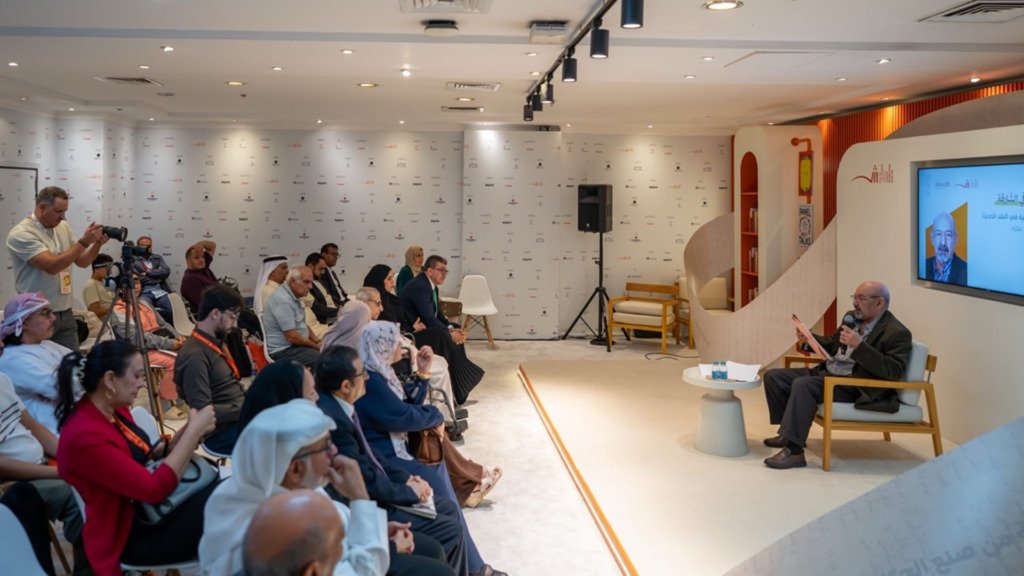
Saïd Bengrad during a lecture at the Sharjah International Book Fair
A text “is not a political statement,” Moroccan semiotician Saïd Bengrad said during a lecture at the 45th Sharjah International Book Fair, addressing modern criticism, the hidden intent of literary works and the place of imagination in human life.
The Moroccan academic also dismissed the notion, once advanced in social-science studies, that a text is merely “a cunning trick to divert people from true consciousness.” Texts, he argued, are “closed entities that hold secrets,” shaped by a particular decision for which the writing self is not solely responsible.
An intent that protects the text
Bengrad, author of “Masalik al-Ma’na” (Paths of Meaning), a study of some of the systems of Arab culture, said every text carries “an intent that protects it.” Readers can only enter it within limits, he said, unlike the analytical frameworks that in earlier decades set both the critic’s field of work and the amount of meaning that could be drawn from a text.
Writing draws on a shared human encyclopaedia, yet its worlds take shape through aims that cannot be imposed from outside, among them the constraints of the creative self. A text, he said, “builds its truth on its internal structure,” its meaning springing from an added symbolic charge: words are not used simply to say something, but to find pleasure in how they are arranged.
Language, in his view, responds first to social needs, among them the classification of the world’s things and beings. “Every name is part of an experience,” he said, describing it as a lived experience made general through the collective use of language. “The world was born in the human being who named it,” he added.
No innocent words
Every experience of meaning is necessarily incomplete, Bengrad said, and this incompleteness is what drives people to write poetry, sing songs and play with words. “What we truly read is an interpretation, and interpretation is an activity inherent in all speech,” he said, adding that pleasure slips into the gap between signifier and signified.
“The innocent word died the day it fell into the hands of the human being; it lost its virginity and became a carrier of meanings of bad faith.”
That, he said, is no cause for alarm. Figurative speech teaches us to discover what is hidden in the passing details of our lives, and myths, rituals and beliefs should be read as new ways of approaching reality rather than worthless tales, since reality itself is only known through forms of representation. He pointed to science-fiction films, where aliens differ from us in everything except the eye, the ear and the nose.
Imagination as escape
On what makes texts seductive, the semiotician compared reading to sight: nakedness does not seduce, and a text that says everything stirs no curiosity. What draws readers in is what stays unseen, and the critic’s task is to push a text beyond its literal meaning, uncovering the intentions not only of the speaker but of the utterance itself.
Turning to imaginary figures such as the ogre, often invoked to describe human anger, Bengrad said that although it does not exist, it carries values that spread among people. “Life in its original sense is very poor, and were it not for imagination we would be poor,” he said, describing imagination as an escape and an attempt “to be more than I am,” even without any real ability to do so.
 CAF Awards 2026: Hanane Ait El Haj leads Morocco’s nominations in four categories
 Family Code reform: Kenitra lawyer urges government to send bill to Parliament
 Waitrose Christmas ad: Keira Knightley in wedding gown in sequel teaser
 BYD’s Yangwang U9 Xtreme wrecked on a closed track before 500 km/h attempt
 Assem Laalami Brings Twenty Years of Film and Studio Work to THE E.L Signature



Comments (0)