



Zellige: the hand-cut geometry of Fez
Zellige is Morocco’s hand-cut mosaic, glazed terracotta chipped by hand into stars and lattices, and Fez has been its capital for a thousand years.
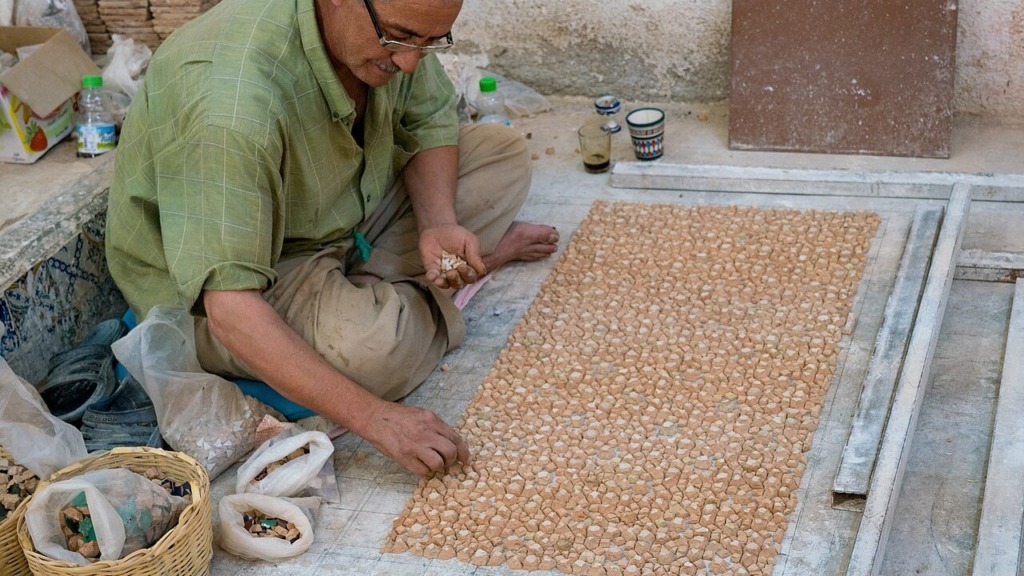
A craftsman in Fez sitting on the floor assembling small zellige tiles into a panel
In a workshop in the Fez medina, a craftsman sits on the floor with a small hammer and a pile of glazed squares. Each square is cut into a shape, a star, a triangle, a kite, and laid face-down beside hundreds of others until a pattern appears. This is zellige, the mosaic that has covered Morocco’s walls for a thousand years.
What it is
Zellige is a mosaic made by hand. Squares of glazed terracotta are cut into small geometric shapes, laid face-down in star and lattice patterns, and then fixed in plaster. The name comes from Arabic al-zulayj, polished stone. The work covers walls, floors and fountains in madrasas, mosques, palaces and riads across Morocco, and it now appears in homes far from the country, valued for its handmade texture. No two panels ever come out identical, because each piece passes through glazing, firing and cutting by hand.
From clay to wall
It starts with clay from the Fes region, soaked and kneaded by hand and often by foot, to drive out air and impurities. The clay is shaped into square tiles about 10 centimetres across and 2 centimetres thick, then glazed on one face with enamel tinted with minerals: blue from cobalt, green from copper, the colour of terracotta from iron oxide. The tiles are fired in kilns fuelled by wood, at heat reaching 900 degrees Celsius.
Then comes the hardest part of the job. A cutter breaks each fired square into exact shapes with a sharp hammer called a menqach, holding the tile face-down as he chips away at its terracotta back. Some pieces are as small as a fingernail, and every one must be exact, or the pattern will not come together. The pieces are arranged face-down following a wooden template, then set in plaster. A wall panel four feet by six can mean weeks of work for a team of cutters.
A thousand years of stars
The craft appeared in Morocco in the 10th century, when mosaic techniques arrived from Mesopotamia and the wider Islamic world. Its patterns follow the Islamic art tradition of abstract ornament rather than images of people and animals, and the repeating geometry speaks of a creation without end.
Zellige flourished under the Almoravids and reached its height under the Marinids, who ruled from the mid-13th to the mid-15th century. In the early 1300s, the madrasas of Fes were lined with zellige below carved stucco and cedar: Bou Inania, built between 1351 and 1356, Al-Attarine, from the 1320s, and the Seffarine. The craft never stopped. The Hassan II Mosque in Casablanca, built from 1986 to 1993, was made the same way, by hand, on a monumental scale.
The masters of Fez
Fes is the craft’s most famous centre. In the old medina of Fes el-Bali, a guild system wrote down the rules of the craft and handed them from master to apprentice, and the masters, the maâlems, still pass the knowledge on by showing rather than telling: the angle of the menqach strike, the kiln heat that makes each glaze colour, the grids that let a master grow a sixteen-point star from a small sketch to a wall ten metres wide.
The workshops cluster in the medina, above all around the R’cif and Ain Nokbi neighbourhoods, where visitors can watch the cutting and setting by hand. The basic motif is the eight-point star, eight points spreading out from a centre with smaller filler shapes around it, and the more complex work adds twelve-pointed and sixteen-pointed stars.
Where to see it
The finest zellige is in the Marinid madrasas of Fes. At Bou Inania, it runs along the foot of the courtyard walls, with carved stucco above it, and carved cedar higher still. At Al-Attarine, the tilework is just as rich. Casablanca’s Hassan II Mosque shows the same craft on the scale of a modern monument. And in homes, hotels and restaurants from Marrakech to Manhattan, Moroccan zellige now appears as a mark of handmade luxury, each panel slightly different from the last, because no machine ever touched it.





Comments (0)