


The Moroccan caftan’s global comeback
A year after UNESCO listed the Moroccan caftan as intangible heritage, it stars on world runways, and Casablanca hosts its caftan festival tomorrow.
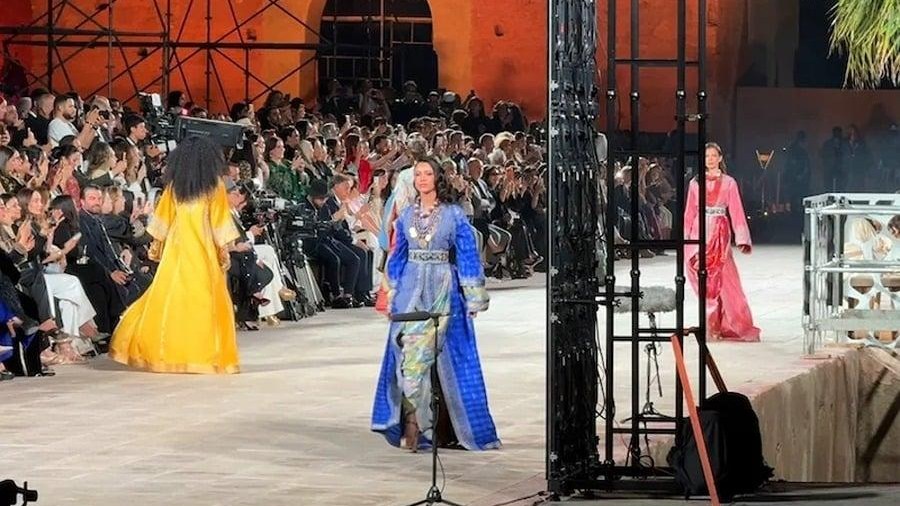
Models in colourful caftans on a runway before a seated audience
On December 10, 2025, UNESCO inscribed “Moroccan Caftan: art, traditions and skills” on its Representative List of the Intangible Cultural Heritage of Humanity, at the 20th session of its safeguarding committee in New Delhi. A year later, the garment is everywhere: in Paris, Milan and New York fashion weeks, at fashion weeks in Brussels and Brasilia, and tomorrow, Saturday, November 28, at the 11th International Moroccan Caftan Festival in Casablanca.
The caftan has moved beyond wedding ceremonies. In 2026 it has become a centrepiece of global high fashion, an emblem of lasting elegance against the uniformity of fast fashion. Houses such as Dior and Saint Laurent take cues from Moroccan cuts and techniques.
Marrakech sets the stage
Caftan Week returned for its 26th edition in Marrakech, running from May 7 to 10, 2026, under the theme “Breath of the Atlas”. Organised by the magazine Femmes du Maroc, the week ended with a grand show inside the historic Palais El Badi, before more than 1,000 guests, including designers, artists and fashion insiders.
Twelve Moroccan designers presented their interpretation of the theme. Among them were Zineb Ghazali, Sara Hilali and Mouad Chafai, alongside Myriam Bouafi, Imane Tadlaoui and Selma Senaoui. Asmaa Naji, Hind Lamtiri and Houda Larini also showed collections, as did Zainab Fatihi Aderrab, Amal Soussi Aouad and Mao Lakhdar. Alongside the shows, the week offered exhibitions, meetings for professionals, masterclasses and a runway devoted to emerging designers.
Ichrak Moubsit, director of Femmes du Maroc and organiser of the event, said the edition sought to raise the caftan’s profile abroad and to promote the artisan trades and regional heritage behind Moroccan haute couture. The show’s collections drew on the mineral tones and craft richness of the High Atlas, and designers described the week as a tribute to the country’s living heritage and to the mountain artisans whose work inspires new generations.
The caftan’s year did not stop in Marrakech. In May it arrived in Belgium, where the first Moroccan Caftan Week in Brussels gathered designers, artisans and fashion lovers, and it headlined the Brasilia Trends fashion week in Brazil. At the Marrakech International Film Festival this week, the caftan has led the red carpet.
The craft behind it
Behind the runways is a craft built by hand. The craft has regional signatures: embroidery from Fes, beading from Rabat, and the sfifa braid of Marrakech, prized as marks of the finest quality. Artisans known as maâlems work them through fine embroidery, rich fabrics and reworked silhouettes. The caftan in Morocco dates back to the end of the 15th century, rooted in the Moorish heritage of Al-Andalus, and the first written record of the garment being worn in Morocco is from the 16th century.
The industry is growing with the attention. Figures published in March 2026 put the caftan industry’s growth over the previous year at 15 percent, helped by social media and by influencers around the world. The following month, industry bodies set a goal of raising high-end caftan exports to the European Union by a fifth by 2027.
Tomorrow’s festival in Casablanca, at the Hilton Garden Inn Casablanca Sud, is the next stop. The 11th edition brings the celebration back to where the caftan is worn every day: not on a runway, but in Moroccan homes, at weddings and family gatherings, in the hands of the artisans who make it.






Comments (0)