


Morocco’s circular economy: between waste challenges and sustainable growth
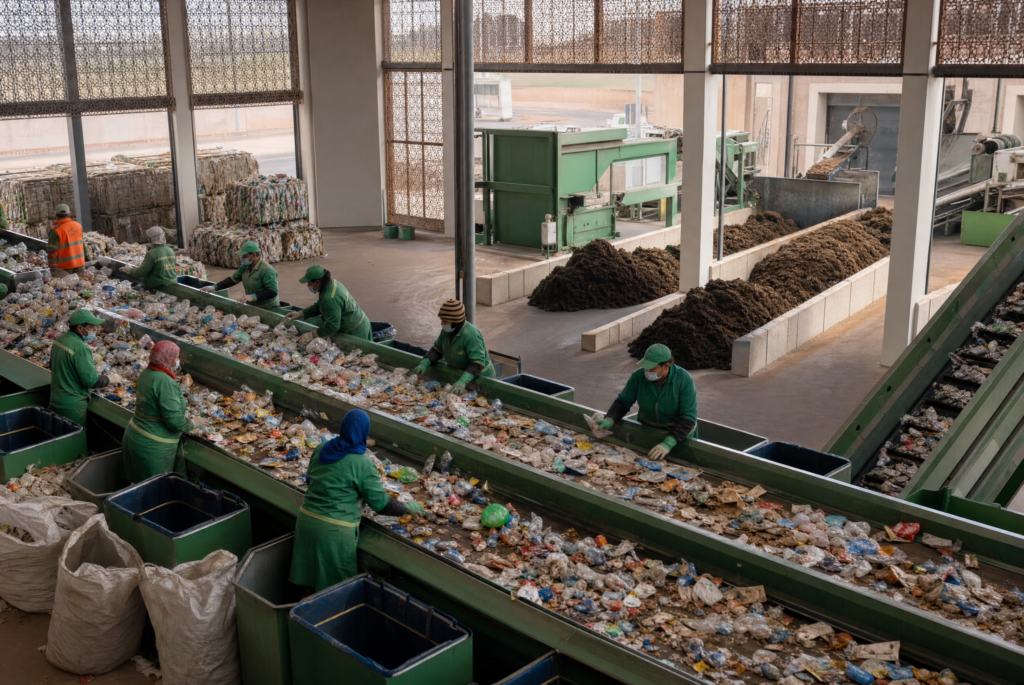
Photo: archive
Waste in Morocco is no longer merely an environmental or technical issue, nor is managing it solely the responsibility of local authorities and public landfills. It has become an economic and strategic challenge that ranks high among development priorities. With continued urban expansion, rising management costs and a growing need to create jobs, the circular economy is emerging as one of the most promising options for reshaping the relationship between production and consumption and for making better use of resources.
The approach rests on a simple principle: feeding used materials back into the economic cycle rather than disposing of them through landfilling or incineration, or leaving them to pile up haphazardly. This is done through sorting, recycling, treatment and reuse. In Morocco, where environmental challenges intersect with the demands of employment and territorial development, this approach is imposing itself as a practical solution required by the current stage, rather than a mere theoretical concept.
Turning waste from a burden into an economic resource
For a long time, waste was seen as the end of the consumption cycle. Yet numerous international experiences have shown that changing this view can open the way to new industries, including recycled plastics, compost and bioenergy, as well as the recovery of electronic waste. In Morocco, this approach is becoming increasingly important as the volume of urban waste keeps rising, alongside mounting pressure on local authority budgets and sanitation services.
However, turning waste into an economic resource does not happen automatically. It requires an integrated system that starts with sorting at source, followed by logistics infrastructure and treatment units, and ends with a market capable of absorbing recovered materials. Without these elements, the circular economy remains closer to a development concept than a fully fledged economic sector.
In this context, a key question arises as to whether the conditions exist for Morocco to shift from a logic of managing waste to one of adding value to it, a question that goes beyond the environment to encompass industry, investment and local job opportunities.
The circular economy and job creation
Job creation is one of the main benefits the circular economy promises. It offers local activities that, in their early stages, require sound organisation, training and management more than large financial investments. These activities include collection, sorting, transport and pre-treatment, making it possible to absorb labour in major cities, peri-urban areas and even some rural communities.
This gives the circular economy an important social dimension, since it is not limited to large companies. It also allows small and medium-sized enterprises, cooperatives, associations and local initiatives to join the value chain, thereby combining environmental protection with job creation.
Achieving these goals, however, depends on a clear regulatory framework, as poor qualifications and the absence of professional and safety standards could turn the field into a precarious activity. Supporting the circular economy is therefore not just about encouraging investment; it also means providing decent working conditions and ensuring the quality of practices within the sector.
The materials with the greatest recovery potential
Waste varies in its economic value and recovery potential. Some materials, such as metals, paper and plastic, lend themselves more readily to reuse, while organic and electronic waste pose more complex challenges.
In Morocco’s case, organic waste is one of the most promising areas, whether through compost production or the development of bioenergy projects, particularly when linked to the agricultural sector.
Plastic waste, meanwhile, is both an environmental challenge and an economic opportunity. Better sorting and more organised collection increase the chances of channelling it into new production streams rather than letting it accumulate in neighbourhoods, waterways and landfills.
Electronic waste calls for strict standards, given that it contains materials of economic value as well as posing potential health and environmental risks. This is where the essence of the circular economy comes into play: it is not limited to recycling alone, but also involves reorganising the life cycle of materials from the moment they go out of use until they are returned to the market.
Integrating the circular economy into public policy
The success of this undertaking requires more than scattered initiatives or pilot projects. It calls for integrating the circular economy into public policy by encouraging investment, developing the legal framework, strengthening public-private partnerships and tying funding to measurable results.
Local authorities also have a key role to play, as they are closest to waste management on the ground. If management remains confined to simply removing waste, no real market for its recovery will emerge. Integrating sorting and recycling into urban and economic planning, on the other hand, would turn the issue into a lever for development rather than a mere sanitation service.
The key turning point lies in treating the circular economy as a productive sector in its own right, one that needs clear rules, precise performance indicators, phased investment and effective, transparent governance.
Towards a Moroccan model of the circular economy
Developing the circular economy does not mean copying foreign experiences. Morocco has its own specific features in terms of infrastructure, consumption patterns, territorial distribution and the nature of its economic fabric. Nevertheless, a national model can be devised that turns waste into a local economic resource and converts part of the burden borne by local authorities into tangible productive opportunities.
The main challenge remains moving from waste management as a short-term response to a structured investment vision, in which waste becomes part of industrial planning, green finance and local employment policies, turning it from a burden into a contributor to the national economy.
The future of this path will depend on Morocco’s ability to translate policy directions into practical projects, turn those projects into tangible results and, ultimately, build a sustainable market that makes the circular economy a genuine pillar of development.
 Short-Stature Football World Cup Set for Rabat and Kénitra From Nov. 20
 Asilah: MekkiL Association runs medical caravan in Sahel Chamali douars
 Morocco: Government Council raises direct social aid floor to MAD 600 in 2027
 Agadir to host IWA water systems conference, a first in Africa, in December
 Tangier-Tétouan-Al Hoceïma: Bank of Africa takes circular economy to SMEs
Comments (0)