Mejhoul dates: Khalifa Award official stresses Moroccan roots
At SIDATTES 2026 in Erfoud, Abdelouahhab Alboukhari Zaid of the Khalifa Award said Mejhoul dates are Moroccan in origin wherever they are grown.
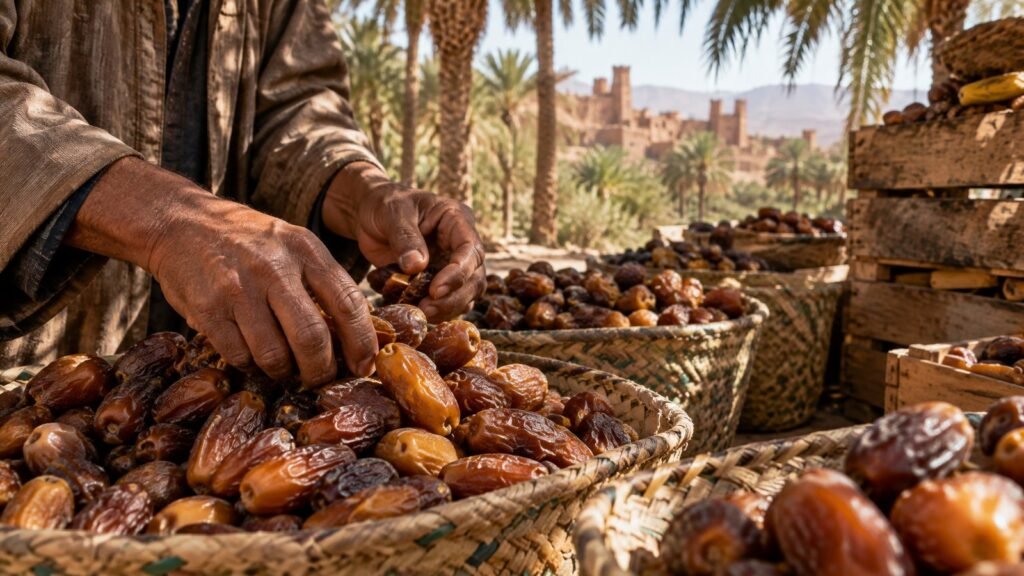
Illustrative image
Mejhoul dates remain Moroccan wherever in the world they are grown, Abdelouahhab Alboukhari Zaid, Secretary-General of the Khalifa International Award for Date Palm and Agricultural Innovation, said in Erfoud, where the 15th International Date Fair (SIDATTES) is being held.
The Emirati official, speaking to Morocco World News, urged greater recognition of the fruit’s origins on the international stage. He placed its cradle in Boudenib, an oasis in Tafilalet.
“It is well recognized and stated that such a variety, the owner and the origin of it is Morocco.”
Cultivation has since spread to many countries, Zaid acknowledged. That expansion, he said, does not erase where the date comes from: “Wherever Medjool is produced, it is of Moroccan origin.”
His view matches that of the Food and Agriculture Organization (FAO), which names Tafilalet as the place the variety was first cultivated. US Department of Agriculture archives point the same way, showing that the Medjool palms planted in the United States were brought over from Morocco.
A dispute over spelling
The name itself is part of the issue. Zaid wants the Moroccan form used instead of the various spellings found abroad. “It is called Majhool and not Mejdul or other names,” he said.
Steps are already being taken, the Secretary-General said, to settle discrepancies in how the date is written and identified. He plans to raise the question with international bodies, including the United Nations system, so that both the genetic character of the palm and its Moroccan heritage are preserved.
On the Moroccan side, “Dattes Majhoul de Tafilalet” has carried geographical-indication protection since 2010, a label reserved for fruit harvested within a defined production zone.
Sixteen years at the fair
The Khalifa International Award has been present in Erfoud from the start. “We started as the festival started in 2010,” Zaid said.
He welcomed what the Emirati pavilion has achieved and argued that trade shows of this kind spur rivalry between producers. Competing side by side, he said, pushes growers to deliver better fruit and smarter packaging, and to build firmer business links with buyers in European and Arab markets.
Beyond the fair, the award assists date farmers in Mauritania, Egypt, Jordan, Sudan, Ethiopia, Pakistan, Mexico and other countries, enabling them to exhibit abroad and exchange know-how. At this edition, eight countries are represented through 20 exhibitors in the Emirati pavilion.
100,000 visitors expected
Running from Wednesday, October 28, to Sunday, November 1, SIDATTES 2026 hosts roughly 230 exhibitors, with attendance forecast at about 100,000.
The theme chosen for this year is “Date Palm and Innovation: Opportunities for Integrated Territorial Development.” Alongside the stands, the programme offers investment forums and scientific talks, as well as displays focused on sustainable oasis development.