Migration governance in Morocco strengthens territorial inclusion efforts
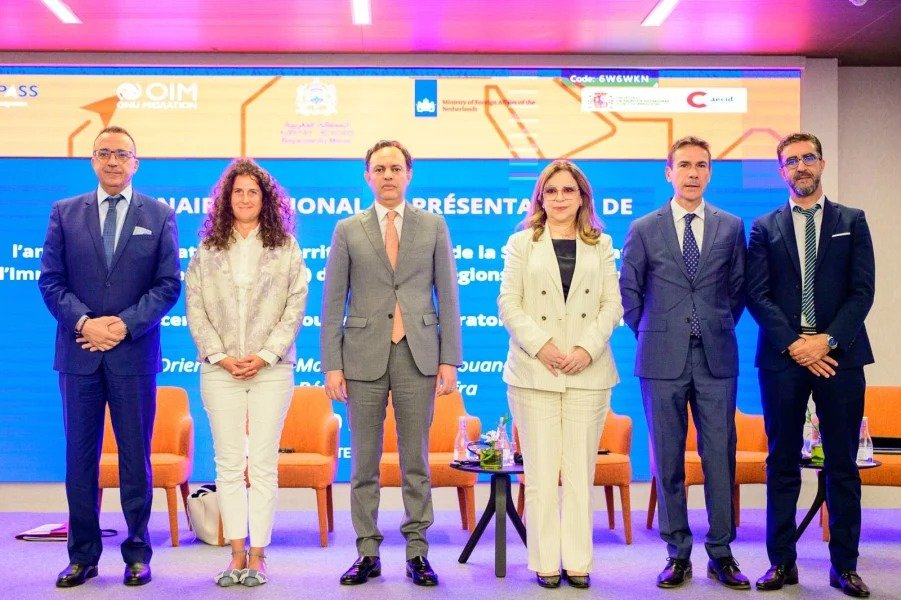
The International Organization for Migration presented in Rabat the findings of a comparative study on the territorial implementation of Morocco’s National Immigration and Asylum Strategy across four regions, including the Oriental, Souss-Massa, Tanger-Tétouan-Al Hoceïma and Béni Mellal-Khénifra. The analysis highlights how migration governance is evolving from a centralized model toward a locally driven approach anchored in regional realities.
The study places territorial governance at the center of migration policy effectiveness. It shows that local authorities, decentralized state services and community actors now play a decisive role in translating national migration objectives into concrete actions. These actions focus on improving access to essential services, strengthening socio-economic inclusion and reinforcing social cohesion in host communities.
Migration in Morocco reflects complex and multi-layered dynamics. The country experiences emigration, immigration, return movements, transit flows and internal mobility. Since the 2013 royal orientations calling for a comprehensive migration and asylum policy, Morocco has undertaken a structural reform process through the National Immigration and Asylum Strategy. This framework has positioned the country as a regional reference in migration governance reform.
According to the findings, the territorial ownership of migration policy depends largely on coordination between institutions and the presence of structured projects supported by technical and financial partners. Regions where collaboration between stakeholders is stronger tend to show more advanced inclusion outcomes for migrants.
Local actors underline a shift in approach toward more human-centered governance. A regional official involved in the study emphasized that migration policies are increasingly built around individuals and their daily needs. This approach supports closer proximity between public services and migrant populations, improving responsiveness and adaptability.
The study also identifies several regional practices that illustrate progress. In the Oriental region, efforts have focused on access to basic services such as education and healthcare. In Tanger-Tétouan-Al Hoceïma, initiatives have promoted intercultural dialogue and vocational training programs aimed at improving employability. Souss-Massa stands out for the coordination of territorial stakeholders working jointly on migration-related development projects. Béni Mellal-Khénifra has also contributed to strengthening local inclusion mechanisms through community-based initiatives.
Migrants participating in the assessment highlighted the importance of social and cultural access in their integration process. Sports activities, recreational spaces and open public infrastructure were identified as key factors contributing to a sense of belonging. These elements complement formal policies by fostering everyday interaction between migrants and local communities.
Despite these advances, the study points to persistent structural challenges. Human resource shortages in migration management remain a major constraint at local level. Financial resources are unevenly distributed, limiting the capacity of certain regions to implement sustained programs. Many initiatives still depend on international funding, which raises concerns about long-term sustainability. The analysis also notes the absence of clearly defined migration competencies within the legal frameworks governing local authorities.
These limitations reflect broader governance gaps that affect the consolidation of territorial migration policy. Coordination mechanisms between national and local institutions require further strengthening. The need for specialized training in migration management is also highlighted as a priority to improve policy implementation at regional level.
A multi-stakeholder seminar brought together national institutions, local authorities, decentralized services, civil society organizations, private sector actors, academic institutions and migrant representatives. Discussions focused on improving coordination, sharing best practices and reinforcing territorial planning tools to better integrate migration into local development strategies.
The event was supported by the Spanish Agency for International Development Cooperation and the COMPASS program funded by the Ministry of Foreign Affairs of the Netherlands. It emphasized the importance of international partnerships in supporting Morocco’s migration governance framework while reinforcing local ownership.
Participants agreed on several recommendations aimed at strengthening territorial governance. These include improving institutional coordination, enhancing local capacities, and integrating migration more systematically into regional development planning. The recommendations also stress the need for more sustainable financing mechanisms that reduce dependency on external funding.
The International Organization for Migration reaffirmed its commitment to supporting Morocco in building an inclusive and territorially grounded migration governance system. The approach emphasizes proximity, cooperation and adaptation to local realities while ensuring that migrants and host communities benefit equally from public policies.
The findings underline a broader transformation in migration governance, where local action becomes a central driver of national policy effectiveness. The territorial dimension is no longer a secondary component but a core element shaping outcomes on inclusion, cohesion and development.