



NASA probe swings by Earth on 3 December for a gravity boost
NASA’s Europa Clipper spacecraft will swing past Earth on Thursday 3 December 2026, borrowing the planet’s gravity to gain speed for its long journey to Jupiter, where it will investigate whether the ocean beneath the moon Europa’s ice could harbour life.
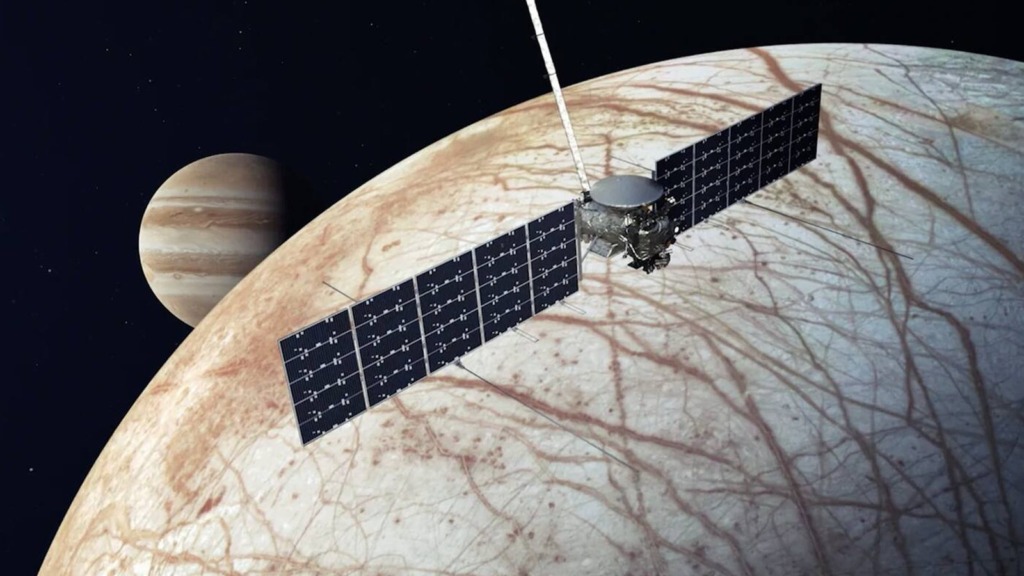
An artist's rendering of NASA's Europa Clipper spacecraft flying over Europa, with Jupiter in the background
On Thursday 3 December 2026, a spacecraft the size of a basketball court will come home for the last time. Europa Clipper, NASA’s probe to Jupiter’s moon Europa, will pass just 3,140 to 3,450 kilometres above the Earth, borrowing our planet’s gravity to fling itself onward to the outer solar system. NASA announced the manoeuvre on 25 November, describing it as both a fuel-saving trick and a dress rehearsal for the science that lies ahead.
The nearest point lies off Africa’s west coast at 3:14 p.m. EST, which is 9:14 p.m. in Morocco. At 6,000 kilograms, Europa Clipper is the biggest spacecraft NASA has ever sent into deep space, and the flyby will bend its path and add speed for the long cruise to Jupiter. It is due to settle into orbit around the giant planet in April 2030, after a journey of 2.9 billion kilometres lasting five and a half years.
The technique is called a gravity assist, and it is how deep-space missions travel without carrying impossible amounts of fuel. A spacecraft steals a little of a planet’s orbital momentum, changing its own speed and direction instead of burning propellant. Robert Pappalardo, the mission’s project scientist at NASA’s Jet Propulsion Laboratory in Southern California, put it simply: the probe dives into Earth’s gravity well, follows the curve of the planet, and shoots back out again, pulled along and moving faster than before, on a slightly altered course.
Clipper has already played the same trick once, in reverse. In March 2025 it skimmed 884 kilometres above Mars, letting the Red Planet’s gravity slow it down and bend its path around the Sun so that it would loop back toward Earth. Now Earth will do the opposite and add energy for the outward leg. The two encounters together supply the energy the spacecraft needs to reach Jupiter; a direct flight would have demanded far more propellant than the probe could carry.
A rehearsal for nine instruments
For the navigators, the flyby is about saving fuel. For the scientists, it is a chance to test their tools. Every one of the spacecraft’s nine instruments will be switched on and gathering data as it passes Earth, in what NASA calls another crucial milestone for the mission.
One instrument matters more than the rest during this pass: the magnetometer. At Jupiter, it will examine how the giant planet’s magnetism affects Europa, looking for proof of the huge ocean thought to hide beneath the moon’s ice. Earth’s magnetic field is well mapped, so measuring it on the way past gives the team a trusted reference point before the instrument measures a field no one has ever sampled.
The spacecraft left Earth on 14 October 2024, launched by a Falcon Heavy rocket from Kennedy Space Center in Florida. Once its solar panels are fully extended, it measures 30.5 metres across, wider than a basketball court. That size is forced on it by its destination: sunlight at Jupiter is 25 times fainter than at Earth, so the probe needs vast panels to collect enough power to work.
Reaching Jupiter is only the start of the hard part. Before it can settle into orbit, Clipper will brake against the gravity of Ganymede, another of Jupiter’s moons, and let itself be captured. It will then circle the giant planet and sweep past Europa about 49 times over four years, studying the moon’s ice, ocean and chemistry. It will not orbit Europa itself, because the radiation belts around Jupiter would wreck its electronics.
Moroccan skies get a front-row seat
People near the flyby path may even be able to watch it happen. NASA says the spacecraft should be visible through relatively large amateur telescopes along the closest-approach track, especially in southern Europe and Africa. Because the nearest point lies west of Africa, observers on the continent, including in Morocco, are well placed. The Oukaïmeden Observatory in the Atlas Mountains near Marrakech is one of the region’s best-known places to look up.
For Morocco, the event is a reminder that the country already watches the same sky the great missions fly through. Moroccan universities and astronomy clubs have a growing community of observers, and a spacecraft passing over the Atlantic just west of Africa is an invitation to look up. The probe itself will be no more than a faint, fast-moving point of light, but the idea behind it is easy to grasp: a machine built by human hands, borrowing the Earth’s own motion to reach a frozen ocean world where life might exist.
The science at stake is enormous. Europa ranks among the most promising places in the solar system to look for life beyond Earth. Under its cracked shell of ice lies a global ocean that scientists believe holds twice as much water as all of Earth’s oceans put together. If that water touches a rocky sea floor, it could hold the water, chemistry and energy that life requires. Clipper will not hunt for life directly, but it will settle whether the conditions for life are there at all.
Once the 3 December pass is over, the spacecraft enters a long, quiet cruise, with little news expected until it arrives at Jupiter in April 2030. For more than three years it will cross the dark between the planets, carrying nine instruments toward a moon it will not see at close range until the spring of 2031. The Earth flyby is the last time the probe will come home, and the last push it needs before it leaves for good.








Comments (0)