Ceuta crisis faces scrutiny over claims of an organized operation
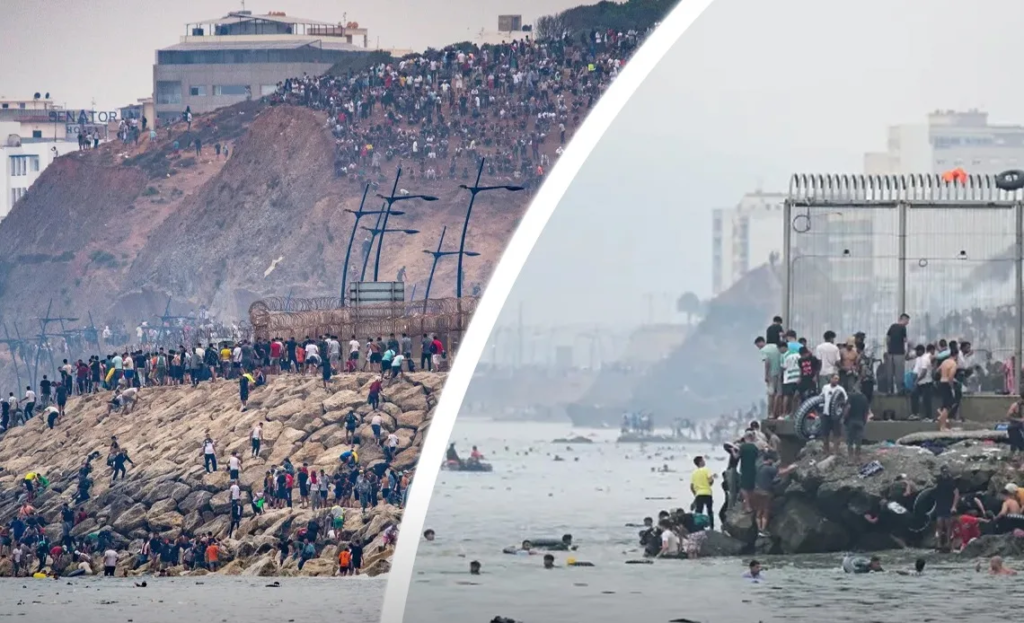
A report cited by Spanish media has described the mass crossings into Ceuta on July 30 and 31 as an organized operation. The claim has renewed debate over the role of social media, migration pressure and Morocco’s border controls, while questions remain over the evidence used to establish coordination.
The report was produced by Golden Owl, a startup linked to the University of Alicante Science Park. It examined activity across Facebook pages and groups associated with calls to travel toward Ceuta. Its analysis identified recruitment messages, shared slogans, repeated keywords and links directing users toward private messaging channels.
The study argues that these patterns indicate a degree of preparation. It also refers to what it describes as selective recruitment, with some participants allegedly grouped according to specific profiles. Anonymous or newly created accounts and coded language are presented as further indicators of an attempt to avoid detection.
Digital activity, however, does not by itself establish the existence of a centralized operation. The report acknowledges that it found no identified leader, hierarchy or institutional structure behind the network it examined. It describes a broad online ecosystem rather than a clearly defined command structure.
A large online network without a clear hierarchy
The analysis reviewed 25 Facebook pages and groups linked to the campaign. It estimated that the main network included about 478,000 members, while the wider ecosystem exceeded one million accounts or members.
The report also recognized that such figures can be distorted by duplicate accounts, reused profiles and overlapping memberships. The size of the audience therefore indicates the reach of the online discussion but does not establish how many people actually participated in the crossings or whether they followed instructions from a central organizer.
Accounts from people involved in the attempted crossings have pointed to a mixture of rumors, viral publications and word of mouth. Some reportedly believed that the border had effectively opened. Others followed friends or responded to information circulating online.
This distinction matters because social media can accelerate collective movement without necessarily providing centralized planning. A large number of users can share the same information and act at roughly the same time without being part of a structured organization.
The report has also referred to possible Algerian connections within parts of the online network. However, the material presented does not establish a concrete operational link. The report itself describes some of these elements as circumstantial.
Migration pressure and confusion over Spanish rules
The events also unfolded after misleading interpretations of a Spanish Supreme Court ruling circulated online.
The court ruled on July 8 on the immediate return of migrants who enter Ceuta by swimming. The ruling did not create an automatic right to enter Spain or to travel onward to the mainland. People entering irregularly remained subject to immigration procedures.
A Moroccan government source argued that confusion surrounding the ruling contributed to the movement toward Ceuta. By the time Spanish authorities clarified the legal situation, misleading interpretations had already spread across social media.
The episode also reflects wider migration pressure in Morocco, where youth unemployment remains a persistent challenge. For some young people, Europe represents an opportunity to seek a different future. That motivation can combine with online rumors and incomplete information to generate rapid movements without requiring a formal organization.
Morocco has also continued to cooperate with Spain on migration control. Moroccan security forces responded to the Ceuta crossings by increasing controls and disrupting networks linked to irregular migration. Spanish authorities have also recognized Morocco’s intervention in containing the movement.
The events therefore place Rabat in a difficult position. Morocco remains a key partner in Spain’s efforts to control irregular migration while also facing accusations from some Spanish political actors over its role in the crisis.
A wider political dispute
The debate over the Ceuta crossings has emerged alongside renewed criticism of Morocco from parts of Spain’s political spectrum. The Spanish far-right party Vox has used the episode to reinforce its criticism of Rabat and its migration policies.
The dispute has also extended beyond migration. Political arguments have emerged over Morocco’s role as a co-host of the 2030 FIFA World Cup, linking the Ceuta episode to broader tensions in bilateral relations.
The framing of the crossings as an organized operation can offer a straightforward explanation for an event involving large numbers of people. Establishing such a conclusion, however, requires evidence of identifiable organizers, command structures, funding or direct operational coordination.
The available material described in the report points to extensive online activity but does not clearly establish such a structure.
The situation around Ceuta has since begun to stabilize. Spanish authorities have reported a sharp decline in crossings, while most Moroccan nationals who entered the enclave have returned to Morocco. Others remain subject to established procedures.
The episode highlights the difficulty of separating organized activity from spontaneous collective movement in the age of social media. Online networks can spread information rapidly and influence thousands of people without necessarily functioning as a centralized organization. Understanding what happened in Ceuta therefore requires examining both the digital campaign and the economic, legal and social factors that shaped the movement.