Spain’s World Cup victory sparks celebrations across Gaza and the West Bank
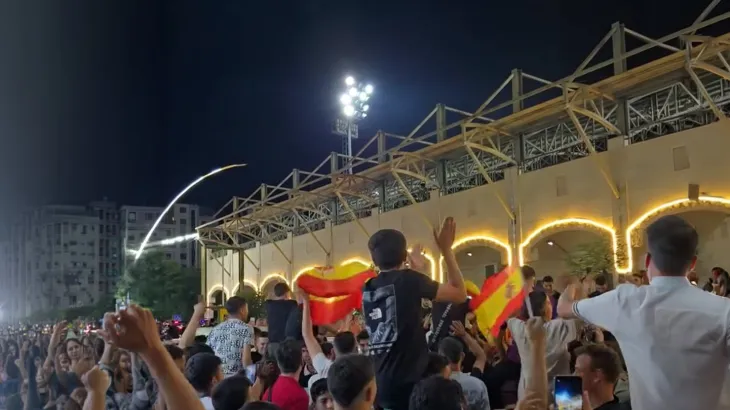
Spain’s World Cup victory became a symbol far beyond football after the national team defeated Argentina 1-0 in the 2026 FIFA World Cup final. The result triggered celebrations among Palestinians in Gaza and the occupied West Bank, while social media users framed the outcome as a symbolic win linked to the Palestinian cause.
The final at MetLife Stadium in New Jersey was decided by Ferran Torres, who scored in the 106th minute of extra time. Long before kickoff, however, the match had acquired political significance due to the contrasting international positions associated with Spain and Argentina.
Spain formally recognized the State of Palestine in May 2024 alongside Ireland and Norway. Argentina, under President Javier Milei, strengthened its diplomatic alignment with Israel, making the final a politically charged event for many observers online.
Israeli Prime Minister Benjamin Netanyahu publicly backed Argentina during the tournament, citing his relationship with Milei. In comments made during an Israeli podcast, Netanyahu praised the Argentine president and linked his support to political ties rather than football allegiance.
Several senior Israeli officials also openly supported Argentina in the days leading up to the final. National Security Minister Itamar Ben Gvir and Finance Minister Bezalel Smotrich used social media to express support for the South American side and praise Milei following Argentina’s run to the final.
Among Palestinians, support for Spain grew throughout the tournament. The team’s victories were frequently accompanied by displays of Palestinian flags, and many supporters viewed Spain as representing a country that had taken a diplomatic position favorable to Palestinian statehood.
According to Al Jazeera, Palestinians in Gaza gathered around makeshift screens to watch the final and celebrated when Torres scored the winning goal. Similar scenes were reported in other Palestinian communities, including among members of the Palestinian diaspora.
In Brooklyn, Palestinian supporters gathered to cheer for Spain during the final. The gatherings reflected a broader sense of solidarity that had developed throughout the tournament.
The political symbolism surrounding the match continued after the final whistle. Hamas official Bassem Naim issued a statement congratulating Spain and expressing support for the celebrations among Palestinians.
The connection between Spain’s football success and Palestinian solidarity had been visible throughout the competition. Spanish actor Javier Bardem displayed a Palestinian flag following Spain’s semifinal victory over France, while supporters increasingly linked the team’s progress to broader political narratives.
Although the World Cup remains a sporting competition, the 2026 final illustrated how international football can become intertwined with geopolitical issues, turning a championship match into a symbolic event for audiences far beyond the stadium.