Israeli strike hits Gaza hospital days after ceasefire announcement
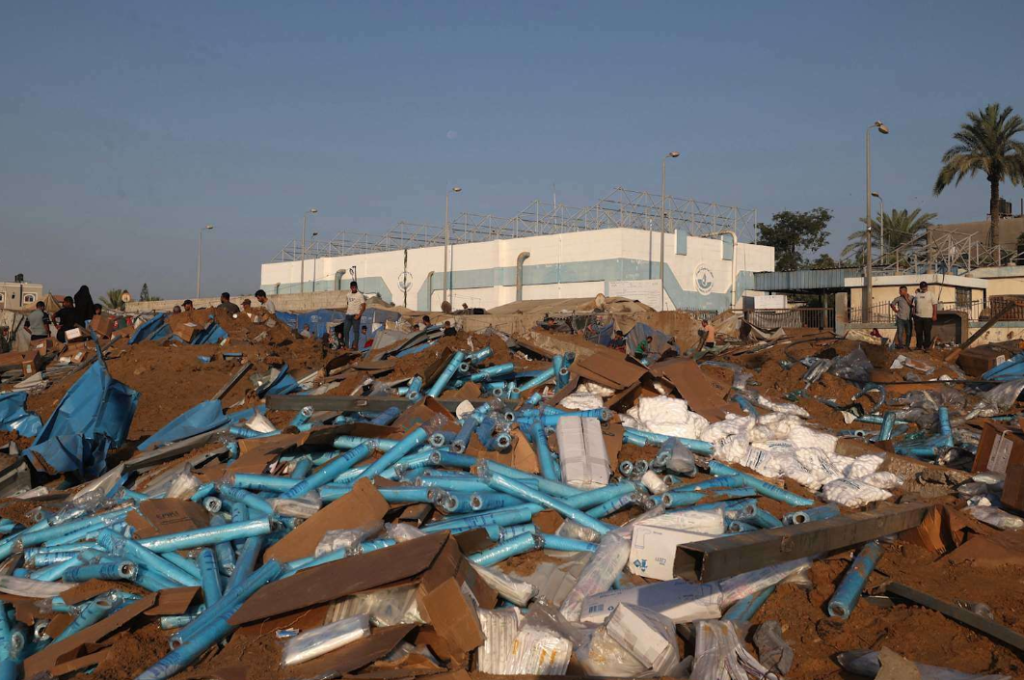
Israeli airstrikes struck Al-Aqsa Martyrs Hospital in central Gaza early Saturday, damaging key medical facilities less than two days after the announcement of a broader ceasefire framework that included a proposed Hamas disarmament plan. The attack comes as uncertainty continues over the implementation of the reported agreement.
According to Gaza’s Health Ministry, the strikes destroyed two medical supply warehouses and damaged two others within the hospital complex. Images from the site showed staff and civilians searching through the rubble to recover intravenous fluids, breathing tubes, surgical masks, and other essential medical equipment.
Dr. Munir Al-Bursh, director general of Gaza’s Health Ministry, said the destruction of medical warehouses further weakens a healthcare system already facing severe shortages. He stated that more than half of Gaza’s essential medicines are unavailable, making the loss of medical supplies particularly significant for hospitals struggling to maintain basic services.
The hospital’s outpatient clinic also sustained damage. Hospital spokesperson Khalil Dagran said no injuries were reported at the facility during the strike. The Israeli military said the warehouses were being used by Hamas to store weapons, an allegation that hospital officials denied.
Elsewhere in Gaza, violence continued despite ongoing diplomatic efforts. Local health officials reported that two Palestinians were killed in a separate Israeli strike in the Sheikh Radwan neighborhood of Gaza City. Another Palestinian was killed in a drone strike targeting the courtyard of a home in Deir al-Balah, according to Anadolu Agency.
Gaza’s Health Ministry says that since the ceasefire that took effect last October, more than 1,200 Palestinians have been killed and over 4,000 injured in what it describes as Israeli violations of the truce. Israel has not publicly accepted those figures.
The latest strikes have cast fresh doubt on the ceasefire initiative announced days earlier by U.S. President Donald Trump, who said Hamas had agreed in principle to a roadmap that includes disarmament as part of a broader political settlement.
Hamas has stated that any first phase of the process requires Israel to halt military operations before further commitments can be implemented. The group has also linked the surrender of heavy weapons to additional conditions that have not yet been finalized.
Israeli Prime Minister Benjamin Netanyahu has not publicly commented on the reported framework. However, an Israeli official said the military would not withdraw from its current positions unless Hamas carries out what Israel considers a genuine and verifiable disarmament.
Israel now controls more than 60 percent of the Gaza Strip after expanding beyond the withdrawal lines established under last October’s ceasefire. Large numbers of Palestinians remain concentrated in a narrow coastal area as humanitarian conditions continue to deteriorate.
Analysts say the absence of a clear implementation timetable for Hamas’ disarmament and for any Israeli military withdrawal leaves the future of the proposed ceasefire uncertain, despite renewed diplomatic efforts.