Al Akhawayn forum highlights AI’s role in shaping youth employment
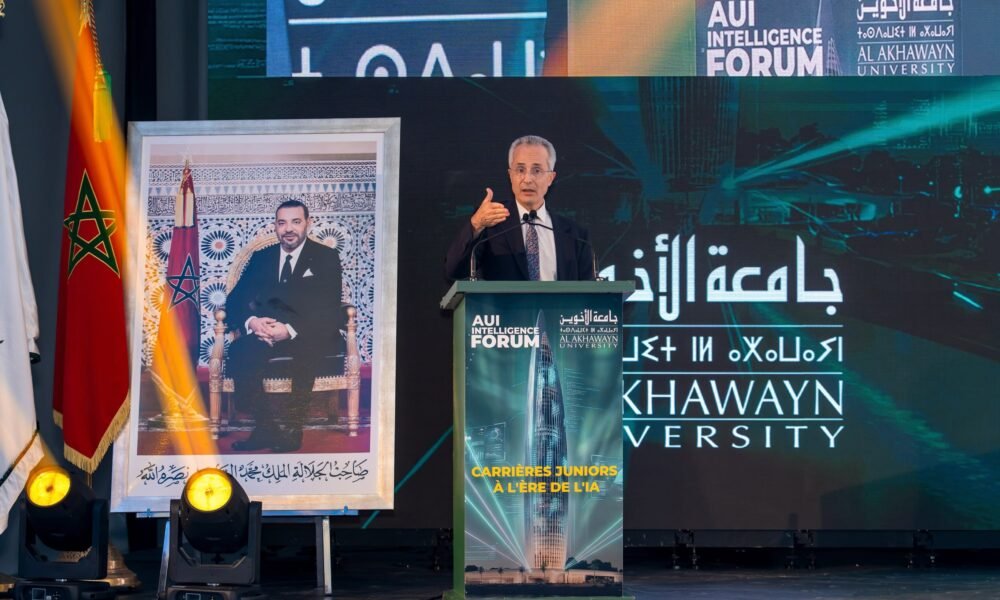
As artificial intelligence reshapes industries across the globe, concerns about its impact on jobs continue to dominate public debate. In Morocco, however, business leaders, policymakers, and academics gathering at Al Akhawayn University’s Intelligence Forum offered a more nuanced assessment. Rather than eliminating jobs, they argued, AI is currently transforming the nature of work and creating an opportunity to redefine how young talent enters the labor market.
Held in Rabat near the Mohammed VI Tower, the forum brought together Higher Education, Scientific Research and Innovation Minister Azzedine El Midaoui, CGEM President Mehdi Tazi, HPS founder and CEO Mohamed Horani, Vocational Training Department Secretary General Wafaa Asri, former minister Awatef Hayar, DecisiveAI founder Ghita Mezzour, École Centrale Casablanca Director General Jalal Charaf, and Al Akhawayn University President Amine Bensaid.
The central question driving discussions was straightforward yet increasingly urgent: how can employers and young professionals create sustainable shared value in an economy increasingly influenced by artificial intelligence?
Participants delivered a message of cautious optimism. Unlike countries where AI adoption has advanced rapidly and disrupted graduate employment pathways, Morocco has not yet experienced significant job displacement among young workers. Instead, AI is altering specific tasks performed by new recruits, changing how work is executed rather than eliminating positions altogether.
Business leaders attending the event emphasized that this distinction is critical. Mehdi Tazi noted that he has not witnessed AI replacing employees across his own companies or among the firms led by fellow executives. In his assessment, more than 90 percent of jobs remain largely unaffected by direct automation today.
Wafaa Asri reinforced this perspective by pointing to international research from organizations such as the OECD and the World Economic Forum. These studies indicate that AI tends to transform individual tasks within occupations before fundamentally replacing entire professions. Entry-level responsibilities are often the first to evolve, making adaptation and training essential for younger workers entering the workforce.
A strategic window of opportunity
One of the strongest themes emerging from the forum was Morocco’s unique position in the global AI transition. Speakers argued that the country still possesses something many advanced economies no longer have: time.
While AI adoption is accelerating worldwide, Morocco remains at an intermediate stage of deployment. This provides institutions, businesses, and universities with an opportunity to prepare workers before large-scale disruption occurs.
That advantage, however, may not last indefinitely. As Moroccan companies seek greater productivity and competitiveness, investment in AI technologies is expected to increase significantly.
Mohamed Horani described the transition as irreversible. According to him, companies are integrating AI into both internal processes and customer-facing products because market competition increasingly demands it. The result is a growing expectation that graduates will arrive equipped with AI-related skills from the beginning of their careers.
Recruitment standards are already evolving. Participants highlighted frameworks such as Capgemini’s classification of candidates into AI Aware, AI Ready, and AI Native categories. In this environment, the ability to use AI effectively and critically assess its outputs is becoming a valuable employment criterion.
Learning from international experiences
The forum also examined lessons from countries that embraced AI more rapidly. According to studies cited during discussions, between 33 percent and 48 percent of recent American graduates remain without employment despite growing corporate demand for AI expertise.
At the same time, 53 percent of companies report difficulties finding workers with the skills needed to support AI transformation.
This apparent contradiction reflects a widening gap between educational outcomes and labor market requirements. Employers need new capabilities, but graduates are not always receiving the training necessary to meet those expectations.
For Morocco, speakers argued, this challenge offers a chance to avoid repeating mistakes seen elsewhere. With an average transition period of 33 months between graduation and first employment and roughly one in four young graduates unemployed, decisions made today could significantly influence future outcomes.
As Wafaa Asri observed, multiple scenarios remain possible. The direction Morocco ultimately follows will depend on policy choices, educational reforms, and the speed at which institutions adapt.
Building a generation enhanced by AI
Rather than framing AI as a threat, participants outlined a vision of technology serving as a force multiplier for human capabilities.
Mehdi Tazi argued that society should move beyond narratives centered on replacement. In his view, AI enables people to become more productive, more informed, and more capable of generating value.
Awatef Hayar illustrated this concept through the example of a rural craftswoman who can now reach international markets using AI-powered tools operating in her native language. Such applications demonstrate how technology can strengthen inclusion and expand economic opportunities.
Jalal Charaf highlighted a similar transformation in higher education. Universities are increasingly preparing students to supervise and coordinate AI agents capable of multiplying individual productivity. The objective is not to compete against machines but to leverage them effectively.
This vision places human intelligence, creativity, adaptability, and interpersonal skills at the center of future economic growth.
Four priorities for the future
Discussions identified four major areas that should guide future action.
The first concerns skills development. Participants called for a common foundation built on critical thinking, adaptability, relational intelligence, and mastery of AI tools. They also advocated integrating AI literacy across all academic disciplines rather than limiting it to technical programs.
The second priority focuses on strengthening cooperation between universities and employers. Expanded internships, work-study programs, joint curriculum development, and corporate academies were presented as essential mechanisms for reducing the gap between education and employment.
The third area involves data governance. Mohamed Horani stressed that data serves as the fuel powering AI systems. He urged Morocco to pursue an ambitious national strategy for data valorization while maintaining technological sovereignty and avoiding dependence on a single provider.
The fourth priority centers on education itself. Participants emphasized the importance of strengthening foundational learning before introducing advanced AI applications. They also highlighted the potential of AI-assisted tutoring to improve educational equity and support students across different regions and socioeconomic backgrounds.
Universities at the center of transformation
Minister Azzedine El Midaoui called on universities to evolve beyond their traditional role and become creators of wealth and innovation.
For Amine Bensaid, collaboration between higher education institutions, businesses, and public authorities represents the most effective way to ensure AI strengthens employability rather than undermining it.
Al Akhawayn University has already taken significant steps in this direction. The institution made AI usage mandatory across all academic disciplines following three years of faculty development and preparation. According to the university, 88 percent of graduates entering the labor market secured job offers before graduation, while students participating in work-study pathways received three to four times more employment opportunities.
Founded in 1993, Al Akhawayn University in Ifrane has built an international academic model inspired by the American liberal arts system. Accredited by the New England Commission of Higher Education, it hosts students from 39 nationalities and collaborates with more than 400 partner universities worldwide.
A defining moment for Morocco’s workforce
The discussions in Rabat reflected a growing consensus that Morocco stands at a pivotal moment in its economic development. Artificial intelligence is advancing rapidly, but its impact on employment is not predetermined.
The challenge is no longer whether AI will become part of everyday professional life. It already is. The real question is whether institutions can equip young people with the skills, adaptability, and confidence needed to thrive alongside these technologies.
For the leaders gathered at Al Akhawayn University’s forum, the answer lies in stronger cooperation between employers and educators, investment in human capital, and a commitment to ensuring that AI becomes a catalyst for opportunity, innovation, and long-term economic growth.