Morocco-Nigeria gas pipeline advances with new ECOWAS agreement
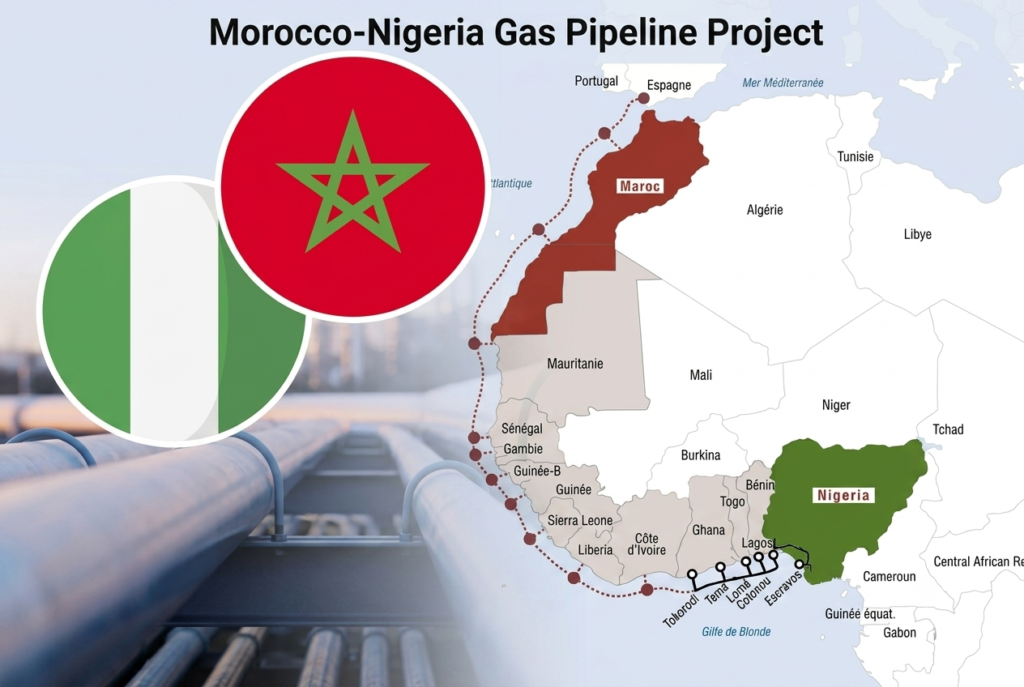
The Morocco-Nigeria gas pipeline project reached a new milestone after member states of the Economic Community of West African States (ECOWAS) signed an intergovernmental agreement governing the infrastructure, also known as the African Atlantic Gas Pipeline. The agreement establishes the framework for the next phase of implementation, including the creation of a project company that will be headquartered in Casablanca.
The Morocco-Nigeria gas pipeline is designed to transport natural gas from Nigeria to Morocco before connecting to the European gas network. Stretching nearly 6,800 kilometers, the project is expected to cross 13 countries along Africa’s Atlantic coast and serve more than 340 million people.
ECOWAS Commission President Omar Alieu Touray said the pipeline ranks among the most transformative initiatives undertaken in West Africa. He noted that the infrastructure would strengthen connectivity between countries, improve energy access, support industrial development, create employment opportunities, and deepen economic cooperation across the region.
Liberian President Joseph Boakai described the project as a transformative investment for the collective future of West Africa. Ghana’s Foreign Minister Samuel Okudzeto Ablakwa also welcomed the initiative, stressing that infrastructure investment remains essential for industrialization and long-term economic development throughout the continent.
Gambia’s Foreign Minister Sering Modou Njie highlighted the significance of the project for ECOWAS countries, emphasizing the role of energy infrastructure in supporting national development programs and regional prosperity.
Morocco’s National Office of Hydrocarbons and Mines (ONHYM) announced that Morocco and Nigeria are expected to formally sign the agreement on the estimated $25 billion project later this year. According to ONHYM Director General Amina Benkhadra, a high-level committee will be established following the signing.
The agreement provides for the creation of a joint venture between ONHYM and Nigeria’s National Petroleum Company (NNPC). The new company will oversee financing arrangements as well as the construction phase of the pipeline.
The initial stage of the project is expected to connect Morocco with gas resources in Mauritania and Senegal before extending through several West African countries and eventually linking to Nigeria’s gas fields. While financing commitments have not yet been finalized, project leaders are working on a funding structure combining equity and debt financing.
His Majesty King Mohammed VI has repeatedly described the pipeline as more than a bilateral initiative between Morocco and Nigeria. The monarch views the infrastructure as a strategic investment capable of accelerating African economic integration, supporting co-development, and creating opportunities for future generations.
Morocco will host more than 1,600 kilometers of the pipeline. In addition to supporting industrial growth across West Africa, the project is expected to contribute to European energy supplies through its connection to existing gas networks.
The initiative also addresses broader challenges facing the continent. Large segments of Africa’s population still lack reliable access to electricity and modern energy services. Supporters of the project argue that developing Africa’s natural gas resources can play an important role in expanding energy access, strengthening energy sovereignty, and supporting economic development across the region.