



Atay: the Moroccan mint tea ritual
Moroccan mint tea, atay, is gunpowder green tea with spearmint and sugar, poured from a height in three glasses: gentle as life, strong as love, bitter as death.
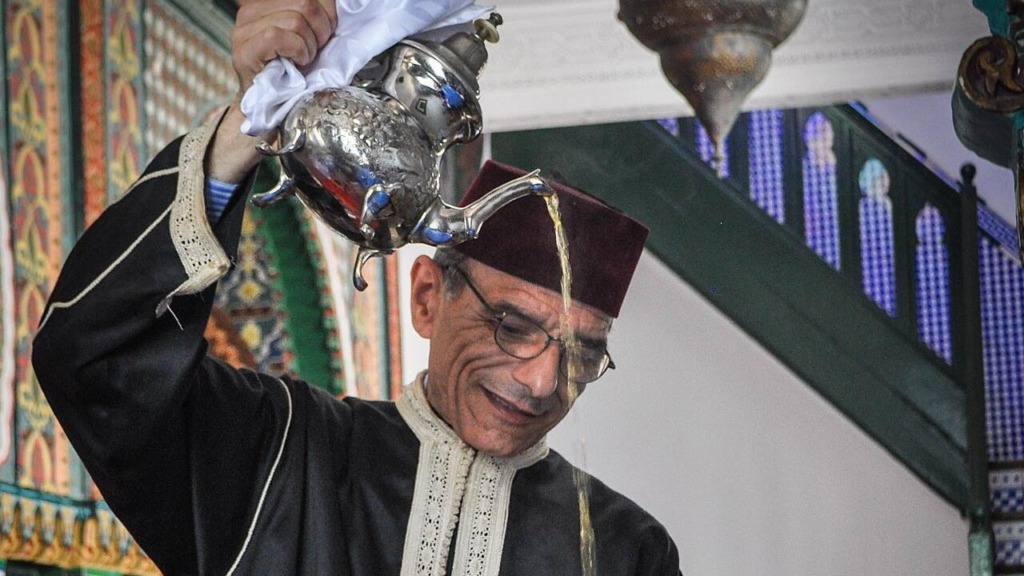
A man in a djellaba pouring mint tea from a silver teapot held high
In Morocco, tea opens every social encounter. A glass offered says you are welcome, that there is time, that talk can begin. What fills the glass is atay: green tea in tight pellets, brewed with a big bunch of fresh spearmint and a generous amount of sugar, then poured from high above into small decorated glasses. It is served in riads, in souks, in Berber tents, after meals, before business talks, and at every celebration.
Three glasses
One pot gives three glasses, and each is stronger than the one before. The old Berber saying runs: first, gentle as life; second, strong as love; third, bitter as death. The first pour is the lightest, mostly mint and delicate, served at once as a sign that you are a guest. In the second, the tea has had more time to steep, and its own flavour comes forward against the mint and sugar. This is the glass for talking. The last is the strongest of the three, with the most tannin, and the sugar works to soften real bitterness. Finishing the third glass means you have taken full part in the welcome.
Moroccans have another saying for visitors: a tea with no mint is a feast with no henna. The mint is spearmint, na’na, never peppermint, and the pot takes far more of it than a newcomer would expect.
The pour
The pour is where skill shows. The pot is lifted 30 to 40 centimetres over the glass, and the tea drops in a thin stream that whips air into it and leaves a fine foam on the surface. That foam is called zbd, and it marks a good pour: a glass with no foam points to a careless hand. The height does two jobs at once, showing off the skill and cooling the tea a little as it falls.
First the tea is rinsed: boiling water swirled over the pellets and thrown out, to take away bitterness. Mint and sugar follow, the sugar as a cone broken straight into the pot, then boiling water to fill it. Three to five minutes of steeping later, the host fills one glass, tips it back into the pot to mix the brew, and fills it again, two or three times, so every glass comes out the same strength. The host sips a little from the first glass to judge the sweetness against the mint. The glasses hold only 100 to 150 millilitres, so the pour must be exact, and the tea is cool enough to drink straight away.
A short history
Tea came to Morocco in the 1700s, carried by trade between Chinese merchants and British intermediaries, and the sultans took to it early. The gunpowder tea still comes almost entirely from China: leaves rolled into tight pellets that open in hot water and give off a faintly smoky, sharp taste, which the mint and sugar turn into something wholly Moroccan.
Even the name has travelled. Atay in Darija may come from the Mandarin word cha, carried along the trade routes south of the Sahara, a sign of how Morocco stands where African, Arab and European worlds meet. In French it is thé à la menthe, and Moroccans sometimes call it whiskey berbère, Berber whiskey, for the ceremony that surrounds it rather than anything in the glass.
More than a drink
In Morocco, atay measures time, opens hospitality and starts every conversation that counts. The teapot, the berrad, is silver-plated brass or stainless steel, slightly bulbous, with a curved spout; the tray holds small glasses, usually ornate, often gold-rimmed. Making it well is an art passed down through generations, and the person who pours is the person who sets the tone of the gathering.
Three glasses is the usual minimum for a full service. You may stop at two, but the third is the gesture that says you belong.
 Morocco v Bolivia in the short-stature semi-final
 Morocco: Government Council raises direct social aid floor to MAD 600 in 2027
 Morocco reach short-stature World Cup semi-finals
 Lavrov’s plane stops in Casablanca again on its way back from Atlanta to Moscow
 Short-Stature Football World Cup Set for Rabat and Kénitra From Nov. 20


Comments (0)