



Voyager 1 reaches one light-day from Earth, a first for humanity
NASA’s Voyager 1 crossed one light-day from Earth early on Wednesday 18 November 2026, becoming the first human-made object ever to reach that distance, about 25.9 billion kilometres away.
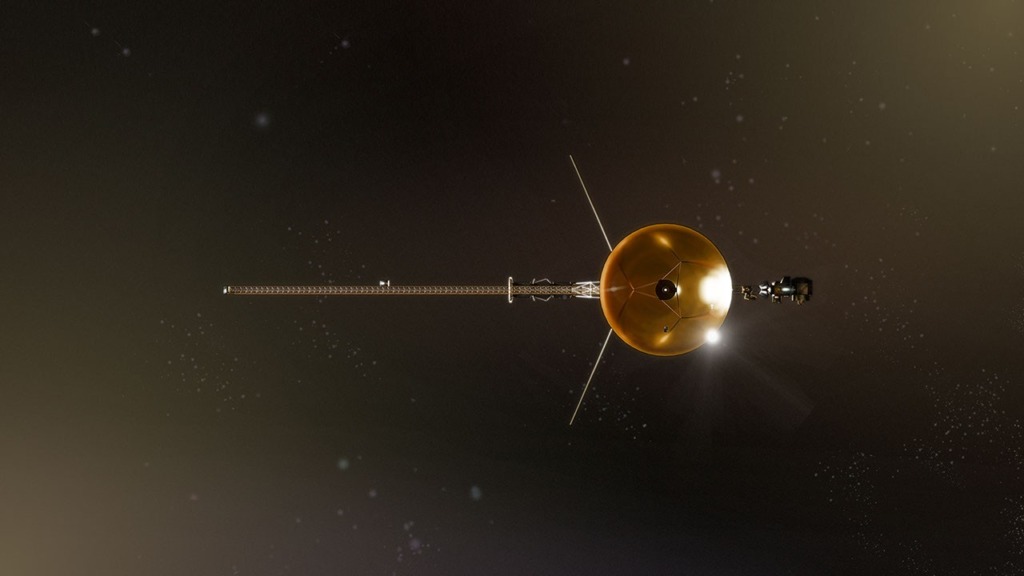
An artist's illustration of the Voyager probes continuing their mission in interstellar space, the region beyond the Sun's heliosphere — not a photograph of the spacecraft
Early on Wednesday 18 November 2026, Voyager 1 crossed a distance no human-made object had covered before, at 5:16:07 a.m. EST, or 11:16 in Morocco. Voyager 1 reaches one light-day with this crossing, the first time any human-made object has travelled so far from Earth.
The probe sat roughly 16.1 billion miles out, about 25.9 billion kilometres, which is how far light gets in a full day. Commands radioed from Earth now need a whole day to arrive, and answers need another day to return.
Voyager 1 departed on 5 September 1977, close to fifty years ago, for a mission meant to last just a few years. Voyager 2 had left Earth sixteen days before it, yet follows a slower route: it remains over 13.4 billion miles out and is not due at one light-day until November 2035.
Voyager 1 reaches one light-day after a journey of firsts
In 1979 the craft swept by Jupiter, and in 1980 it passed Saturn, returning pictures that changed how scientists saw both worlds. Its pass by the moon Io exposed volcanoes erupting on another world, while its Jupiter images were the first to show the giant planet ringed.
14 February 1990 saw the craft aim its cameras homeward one last time, capturing a parting portrait of the solar system that included Earth as the Pale Blue Dot. Those cameras were then shut down permanently. On 25 August 2012, Voyager 1 crossed the heliopause into interstellar space, the realm between the stars, ahead of any other spacecraft.
It now races along at close to 38,000 miles per hour, around 61,000 kilometres per hour, and still obeys orders from Earth. Its signal leaves through a 12-foot antenna from a transmitter about as strong as a 23-watt bulb. Two science instruments are still running: the magnetometer, which measures magnetic fields, and a plasma wave instrument. The rest were powered down to stretch the remaining energy.
That October, the craft fell silent for two days until engineers made contact again, a reminder of how fragile the mission has become. Three generators supply its power, turning the heat of decaying plutonium into electricity, with output fading by roughly four watts a year. The team at the Jet Propulsion Laboratory thinks the Voyagers can stay in touch into the early 2030s.
“The best illustration of just how vast space is. So much of what we dream about is travelling to other stellar systems. And it took Voyager 1 nearly 50 years to get to just the edge of our own solar system, let alone to only a light-day.” — Tiffany Kataria, NASA scientist
Each Voyager carries a Golden Record, a gold-plated copper disc twelve inches across. Etched into it are 115 pictures, hellos spoken in 55 languages, the sounds of surf, wind, thunder, birdsong and whales, plus some ninety minutes of music, and pictorial directions for playing the disc, along with its cartridge and needle. It was assembled as a message from Earth to anyone who might one day find the spacecraft drifting between the stars.








Comments (0)