Why Ceuta dominates the migration crisis over Melilla
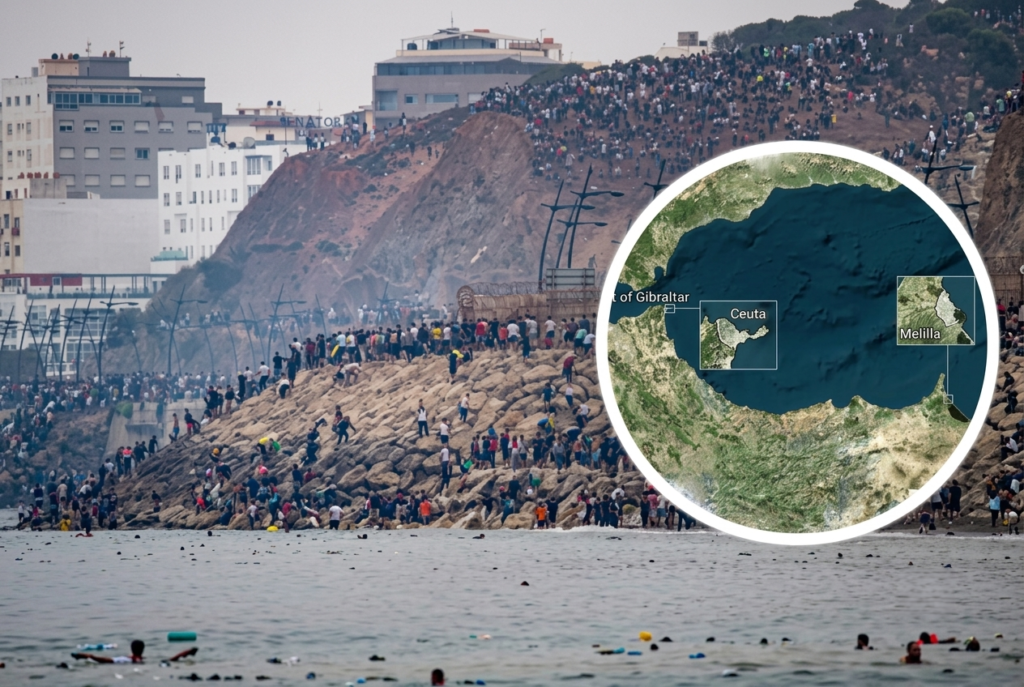
The recent Ceuta migration crisis has brought one of North Africa’s longest-running territorial disputes back into international focus. Images of thousands of migrants attempting to reach the Spanish-controlled enclave have prompted political reactions across Europe and the United States while renewing questions over why Ceuta, rather than Melilla, has become the center of attention despite both being Moroccan cities under Spanish administration.
The answer lies in a combination of history, geography, and migration dynamics that have made Ceuta the main focal point of the latest wave of irregular migration.
Ceuta and Melilla share similar political status but followed different historical paths into European control.
Ceuta was captured by Portugal in 1415 during the decline of Morocco’s Marinid dynasty, marking Portugal’s first major overseas expansion. Melilla was occupied later, in 1497, by the Crown of Castile as Spain expanded along the Mediterranean coast of North Africa.
When Portugal and Spain were united under the Iberian Union in 1580, Ceuta came under Spanish rule. After Portugal regained its independence in 1640, Ceuta remained under Spanish administration, a situation formally recognized between Portugal and Spain through the Treaty of Lisbon in 1668.
Morocco has never accepted that treaty as resolving the city’s sovereignty because it was concluded without Moroccan participation. Since gaining independence in 1956, Rabat has consistently maintained that both Ceuta and Melilla remain occupied Moroccan territories and has repeatedly called for dialogue over their future.
Despite this longstanding dispute, Morocco and Spain have generally managed the issue through diplomatic cooperation while maintaining collaboration on trade, security, and migration.
Geography explains why Ceuta has become the center of the current migration crisis more than history alone.
The enclave borders the Moroccan city of Fnideq and lies only about 20 kilometers from Tangier. Surrounded by the Mediterranean Sea on three sides, Ceuta offers several possible routes for irregular entry. Migrants may attempt to cross the border fence, swim around coastal barriers, or reach the enclave by sea.
Melilla, located around 400 kilometers farther east near Morocco’s Nador province, presents different geographical conditions. Most crossing attempts there are concentrated along the fortified land border, while large-scale maritime crossings occur less frequently because of the coastline and surrounding terrain.
Ceuta’s proximity to densely populated areas in northern Morocco also allows large groups of migrants to gather rapidly near the border, increasing the likelihood of mass crossing attempts.
Migration routes across the western Mediterranean remain highly adaptable.
When authorities strengthen controls at one crossing point, migrants and smuggling networks frequently shift toward locations perceived to offer better opportunities. Weather conditions, border surveillance, and security deployments also influence where crossings take place.
As a result, the concentration of migrants in Ceuta does not necessarily indicate that the enclave is easier to enter. Instead, it reflects the constantly evolving nature of migration routes.
The latest developments have transformed Ceuta into an international political issue extending well beyond Spain and Morocco.
Spanish authorities reported that about 60,000 migrants attempted to enter the enclave over several days, while 67 people were reported dead during the crossings. Images from the crisis circulated worldwide and quickly became part of wider debates over migration and border management.
In the United States, President Donald Trump referred to the events during campaigning ahead of the November 2026 midterm elections, presenting the situation in Ceuta as an example in discussions about American immigration policy.
Although the migration crisis has drawn global attention, Ceuta represents more than a migration route for Morocco. Together with Melilla, it remains one of the country’s oldest territorial disputes. While migration currently dominates international headlines, the question of sovereignty has shaped the history and political significance of both occupied cities for more than six centuries.