Black hole winds found to be 100 times more powerful than expected
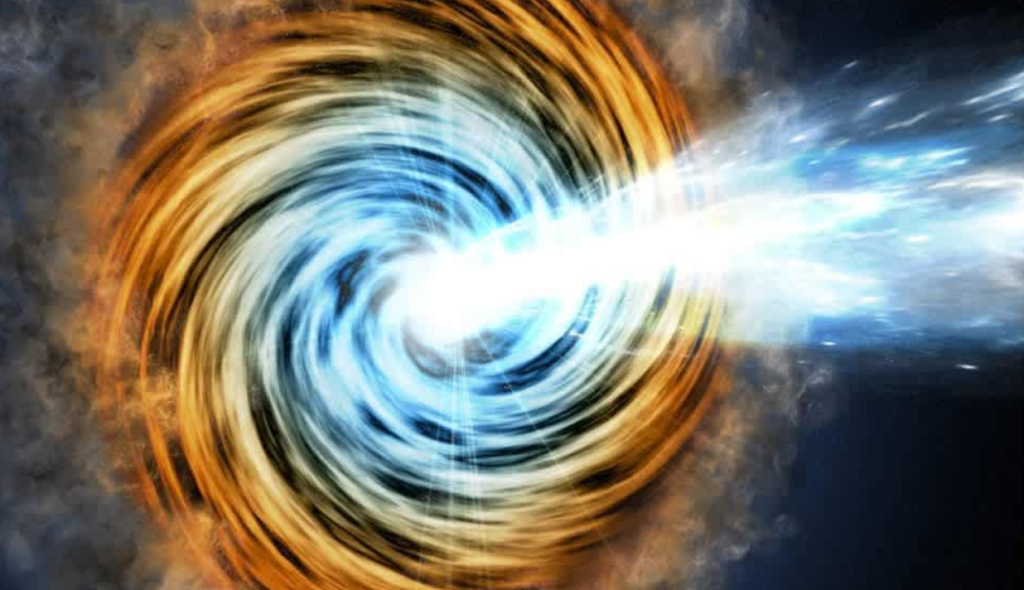
Supermassive black hole winds carry far more energy than scientists previously believed, according to a study published in Nature Astronomy. Researchers found that these powerful outflows release energy comparable to billions of supernova explosions and extend across nearly 300,000 light years, making them about 100 times stronger than earlier estimates.
The discovery comes from observations of the quasar H1821+643, located about 3.4 billion light years from Earth in the constellation Draco. A research team led by Satoshi Yamada, associate professor at the Frontier Research Institute for Interdisciplinary Sciences at Tohoku University, used the XRISM X-ray astronomy satellite to examine the environment surrounding the supermassive black hole.
High precision X-ray measurements revealed that the extremely hot gas around the black hole does not remain still. Instead, intense turbulence drives the gas outward over an enormous region. By analyzing X-ray emission lines produced by iron ions, the researchers tracked the motion of the gas and confirmed that the outflow extends well beyond the host galaxy to distances of around 300,000 light years.
Yamada said black holes are widely known for pulling matter inward, but they also expel gas through powerful winds. Previous models suggested these winds remained largely confined within their host galaxies. The new observations indicate that their influence reaches much farther into the surrounding universe than previously understood.
The researchers estimated that the energy powering the turbulence is roughly 100 times greater than earlier calculations, matching the force generated by billions of supernova explosions. The findings suggest that actively feeding supermassive black holes play a major role in shaping the large scale structure of the cosmos through enormous shock waves that affect the surrounding intergalactic environment.
The study involved researchers from Tohoku University, Kanazawa University, Tokyo Metropolitan University, and several other institutions. The Japanese Institute of Space and Astronautical Science also highlighted the significance of the results.
The findings build on recent advances in the study of black hole outflows. In June, astronomers from Northwestern University reported the first confirmed detection of winds emerging from Sagittarius A*, the supermassive black hole at the center of the Milky Way, ending more than five decades of investigation. While that discovery revealed relatively modest outflows from a dormant black hole, the new XRISM observations capture a far more extreme scenario in which actively accreting black holes generate winds capable of reshaping intergalactic space.